
Reverse engineer anything. Three words, and an entire industry just got nervous.
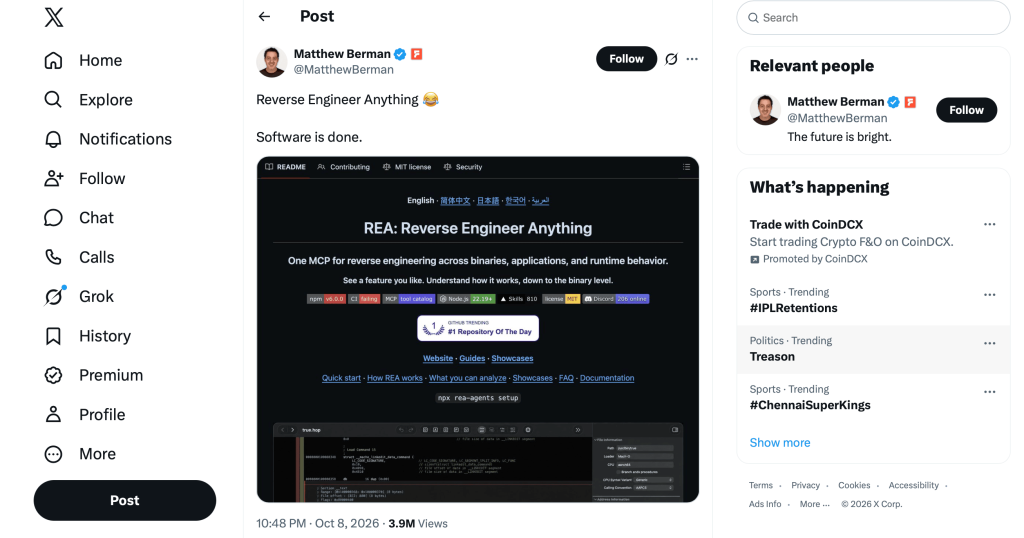
On October 8, AI commentator Matthew Berman pointed his followers to a project called REA, an open-source tool that lets AI coding agents examine software without access to its source code. Within days it was everywhere. If you’ve paid for Photoshop, a Microsoft 365 plan, or a game you can never truly own, you know why it hit a nerve. runtimewire
Here at imfounder.com, we’ve covered piracy across several earlier articles, including how pricing pushes ordinary people toward it, and we’ve gone deep on Adobe’s subscription model. This piece builds on that work. It asks a harder question: if AI makes it possible to reverse engineer anything, is that good for users, or is it a ticking legal bomb?
My answer as a writer is yes, with important conditions. Let me show you why.
1. What Matthew Berman Actually Said About Reverse Engineer Anything
Accuracy first, because this story is already being distorted.
Berman is a repeat founder and one of the best-known AI commentators on X. He promoted REA, and he compared its moment to Napster’s early days. That comparison is the spark. Napster showed that technology can make an entire paid category feel suddenly optional. runtimewire
What is not documented is a call from Berman to clone and give away every app and game on the market. That reading is ours. It’s an editorial interpretation of where the technology points, and I’ll argue it openly. But you should know the difference between what he posted and what the movement could become.
2. How AI Lets You Reverse Engineer Anything Without Source Code
REA, short for Reverse Engineer Anything, is the project behind the buzz. It’s an open-source toolkit that lets AI agents investigate how software works, even without access to its original source code. It connects coding agents such as Claude Code and Codex to established reverse-engineering tools like Ghidra, Hopper, and IDA, and the project has passed 200,000 GitHub stars. You can inspect the REA repository on GitHub and read InfoQ’s report on the project. What Is REA (Reverse Engineer Anything)? Setup and Use Cases +2
Reverse engineering itself is old. Engineers have studied finished products to understand them for centuries. What changed is the cost. Analyzing a compiled program used to take specialists weeks. An AI agent connected to the right tools can now do structured analysis in hours.
That’s the real shock. The skill barrier that protected software companies for decades is collapsing. When you can reverse engineer anything with an AI agent, a product’s complexity stops being a moat.
3. Subscription Fatigue Is the Fuel Behind Reverse Engineer Anything
People didn’t go looking for REA because they love decompilers. They went looking because they’re tired.
Software used to be something you bought. You paid once, installed it, and it was yours for as long as it ran. Now nearly everything is rented. Photo editing, office tools, design suites, cloud storage, even features in cars all come with monthly or yearly bills that never end. Stop paying and your access, and often your own files’ usability, disappears.
This software subscription fatigue is real and measurable in how people behave. Users cancel, hunt for alternatives, switch to open source, or turn to piracy. Reverse engineering tools give frustrated users a fourth path: understand how the software works and build something that does the same job for free.
4. The Adobe Problem: You Pay Forever and Own Nothing
Adobe is the textbook case, and we’ve covered it in detail on imfounder.com. The FTC says Adobe moved to a subscription model after 2012, and that subscriptions now make up the majority of its revenue. In the quarter ending February 27, 2026, subscriptions were 97% of Adobe’s $6.4 billion in revenue. newsshooterarynews
That’s not a side business. It’s the entire business.
The government’s case against the company is worth knowing. The Justice Department and FTC accused Adobe of burying termination fees for its popular “annual paid monthly” plan in fine print, sometimes amounting to hundreds of dollars, and of making cancellation a hassle. In March 2026 Adobe agreed to pay $75 million to resolve the suit, while saying it disagreed with the claims and denied any wrongdoing. The company also agreed to provide $75 million in free services to qualifying customers, bringing the headline figure to $150 million. You can read the official Justice Department release yourself. Adobe pays $75 million to settle US lawsuit over termination fees, subscription cancellations
Fair is fair: a settlement without an admission is not a finding of guilt. But the pattern matters for our argument. When your daily tools are rented, the landlord sets the rules. And since you hold a license rather than ownership, you can’t fix, adapt, or preserve what you paid for.
5. Why Reverse Engineer Anything Feels Like Justice Against Monopolies
Here is the argument I find most persuasive, and the one your instinct is pointing at.
In concentrated software markets, a new challenger faces a brutal choice. Build something better and watch the incumbent copy the best features. Or grow big enough to threaten them and get bought, then quietly shelved. Either way, the competitive pressure that should keep prices honest never quite materializes.
The result is a market where users pay a hefty premium for tools they need every day, because there are no real substitutes. Supporters of the reverse engineer anything movement see AI as the first lever that can break this. If a small team can study how a dominant tool works and rebuild a compatible alternative quickly, then the incumbent’s pricing power weakens. That’s the same dynamic that made open-source operating systems, browsers, and databases viable.
It’s also why this matters beyond design software. Essential, everyday tools becoming genuinely accessible is a public good. When a student in a country with low income can’t afford a professional toolchain, access isn’t a luxury question. It’s an opportunity question.
6. The Law: Can You Legally Reverse Engineer Anything?
Here is where the hype meets the courtroom, and where most viral threads get it wrong.
Reverse engineering is not automatically illegal. Courts have repeatedly protected it in specific contexts:
- In Sega v. Accolade (1992), a US appeals court held that disassembling code to understand compatibility requirements can qualify as fair use.
- In Google v. Oracle (2021), the US Supreme Court ruled that Google’s reuse of Java API declarations was fair use.
- US law also includes a narrow interoperability exception to the DMCA’s anti-circumvention rules.
The Electronic Frontier Foundation keeps a plain-language reverse engineering FAQ that’s worth bookmarking.
But the protection has edges. Copying a program’s actual code or art assets is infringement. Bypassing copy protection can violate anti-circumvention law. Terms of service and license agreements can forbid reverse engineering by contract. And the rules differ from country to country. So the honest answer to “can I reverse engineer anything?” is: you can often study it, you often cannot copy it, and you should never assume.
This is not legal advice. If you plan to build a commercial product from what you learn, talk to a lawyer who handles software and IP.
7. The Line Between Fair Competition and Piracy
This is the point where I part ways with the loudest voices online, and where our piracy coverage on imfounder.com becomes essential reading.
There are two very different things people mean by “free version of every app.”
Clean-room reimplementation. One person studies how a product behaves and writes a specification. A separate team builds new code from that spec without ever seeing the original. This is how compatible competitors have legitimately entered markets for decades. It creates something new and gives users a real alternative.
Copying and cracking. Taking the original code, assets, or license checks and redistributing them. That’s piracy by any definition. It harms the people who made the work, exposes users to malware-laced cracked installers, and hands companies the moral high ground and a legal case.
I defend the first. I don’t defend the second. The monopoly argument justifies competition, not theft. A world where AI helps small teams build honest open alternatives is a better world. A world where it becomes a pirate’s toolkit mostly benefits lawyers.
There’s a practical reason to keep that line clear. Platforms are already pushing back. 404 Media reported that users in the REA community said Claude was refusing to decompile anything. The same outlet earlier described the trend as likely to have a real-world impact on software companies, coding communities, and open-source projects. You can read both pieces: the original 404 Media report and the crackdown follow-up. 404media404media
Napster, the very comparison Berman reached for, ended in the courts. The lesson isn’t that the technology failed. It’s that the movements that lasted channeled disruption into legitimate alternatives.
Our Verdict: Is It Good to Reverse Engineer Anything?
Yes, as a force for competition. Here’s why I land there:
- It restores bargaining power. When users can credibly build or switch to alternatives, pricing has to answer to reality.
- It protects ownership. Interoperability and repair rights depend on being allowed to understand the products we depend on.
- It speeds up open source. The best free tools exist because people studied, rebuilt, and shared.
- It lowers the cost of access. Everyday software reaching more people is worth defending.
But in fairness, the other side has real points:
- Small developers are not Adobe. An indie studio or solo app maker can be crushed by a free clone far more easily than a giant. The “monopoly” argument doesn’t apply to them.
- Games are a special case. Their value is often in art, writing, and design, which clean-room techniques can’t legitimately replicate.
- Cloned software carries risk. Without the original team’s security updates, rebuilt tools can be fragile or unsafe.
- Legal exposure is real. Individuals, not companies, often bear it.
My position: use these tools to study, to build compatible alternatives, and to demand fairer terms. Don’t use them to redistribute other people’s work.
What You Should Do Right Now
If you’re a user fed up with rented software, start with the legal route:
- Audit your subscriptions. List what you pay for and what you actually use.
- Try open-source alternatives for the tools you use least. Many are now genuinely good.
- Check the cancellation terms before you subscribe. The Adobe case shows why.
- Follow REA’s development, but read its license and your local law before using it on anything you don’t own.
If you’re a builder, the opportunity is enormous. The fastest way to compete with an entrenched product used to be a huge team and years of work. With AI-assisted analysis, a small team can understand a market’s incumbent in weeks, and then build something honest and better.
Frequently Asked Questions
Did Matthew Berman tell people to copy every app?
No documented post says that. Reports indicate he promoted REA and compared its moment to Napster. The “free version of everything” idea is an interpretation of where the technology could lead.
What does it mean to reverse engineer anything with AI?
It means using AI agents, connected to analysis tools, to work out how finished software behaves and is built without having the original source code.
Is reverse engineering legal?
Often yes for study and interoperability, as in Sega v. Accolade and Google v. Oracle. But copying code or assets, bypassing copy protection, or breaching a license can still be illegal. It depends on where you live and what you do with the result.
Is this the same as piracy?
No. Studying software and building a clean-room alternative is not piracy. Copying and redistributing the original work is.
Final Thoughts
The reason people want to reverse engineer anything isn’t greed. It’s that software went from something you owned to something you rent, and the renters have grown tired of a one-way relationship. Adobe’s story, with its enormous subscription share and its government settlement, shows why that frustration is justified.
AI has just made a once-elite skill available to almost anyone. Used well, it breaks monopoly pricing and brings essential tools to more people. Used carelessly, it repeats Napster’s mistake: all disruption, no durable alternative.
The choice is ours. Build the alternative, don’t just copy the original.
For our earlier coverage of piracy and the Adobe subscription model, see our related articles on imfounder.com.
Related Articles on IMFounder
- Hardware Subscription Model Trap: Why You’ll Never Own Tech Again
- How Netflix, Paramount, and Comcast Are Competing to Buy Warner Bros
- Why Apple’s Subscription Strategy and Unfixed Bugs Are Pushing Users Away?
- Why Every App Is Becoming a Subscription — And Why Users Hate It
- Why American Farmers Are Fighting Back Against Tractor Giants