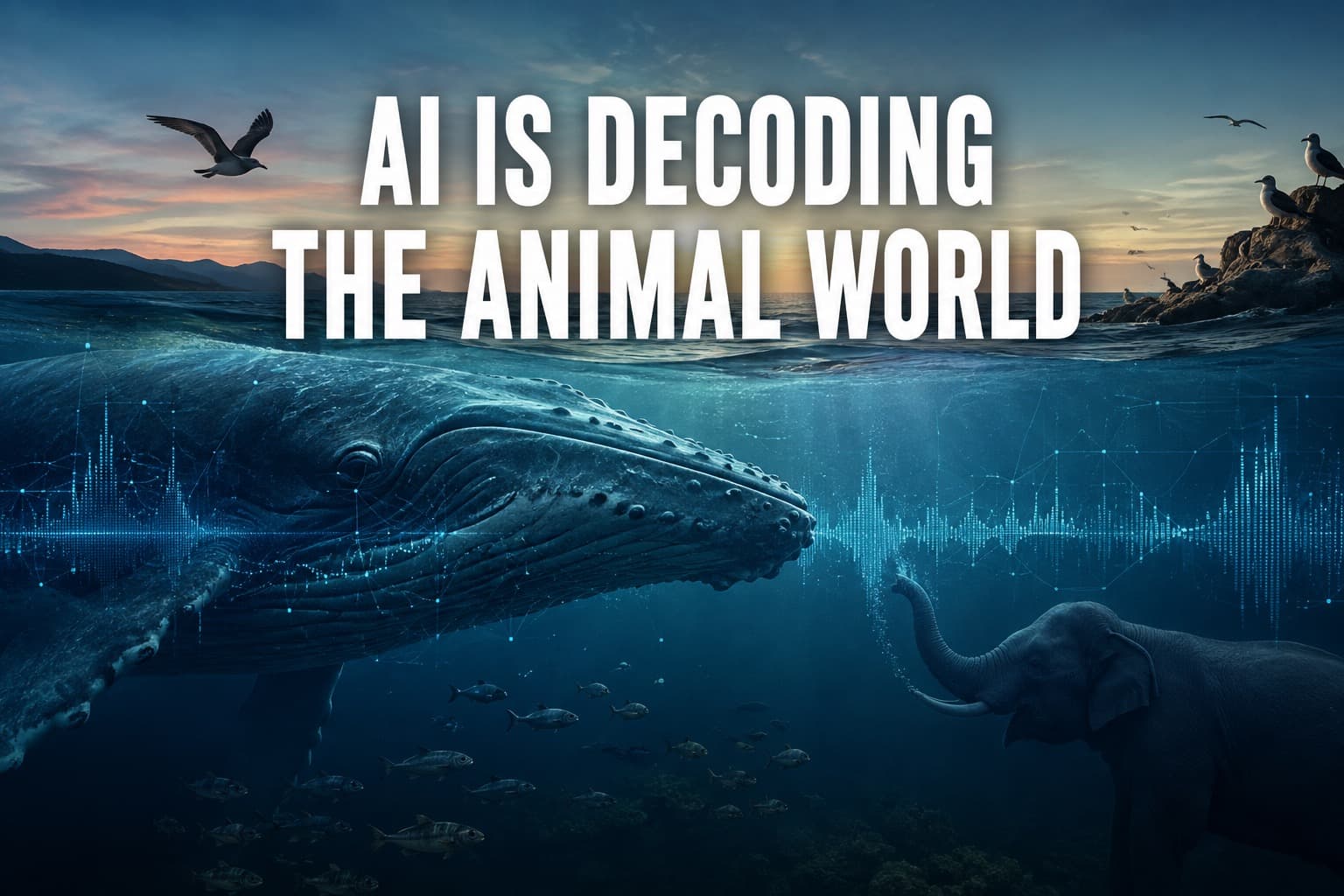

AI Is Decoding the Animal World—and What It Finds Could Rewrite Humanity’s Place in Nature
Somewhere beneath the Caribbean, a sperm whale releases a sequence of clicks into the darkness and another whale answers. The exchange is fast, structured and almost completely inaccessible to the human ear. Scientists have recorded these sounds for generations, cataloguing them and speculating about their purpose, but the scale of animal communication has always created an enormous problem: humans simply cannot listen to millions of interactions across thousands of animals and identify every relationship buried inside them. Artificial intelligence can.
Across oceans, forests and laboratories, researchers are now training machine-learning systems on the sounds of whales, birds, elephants, frogs, primates and other species. The objective has moved well beyond teaching computers to recognize which animal made a noise. Researchers increasingly want AI to determine who is communicating, who answers, which patterns repeat, how vocalizations change with social circumstances and whether apparently simple sounds contain structures humans have failed to recognize. The nonprofit Earth Species Project has gone so far as to describe an emerging discipline around this work as Animal Language Processing.
It is an audacious comparison. Natural-language processing helped computers move from recognizing human words to understanding patterns across enormous bodies of language and eventually generating sophisticated humanlike conversation. Animal Language Processing asks whether similar computational techniques can expose structure inside communication systems that evolved completely outside our species. If it succeeds, one of artificial intelligence’s most consequential discoveries may have nothing to do with replacing humans. It may reveal who else has been communicating around us all along.
“Humanity may have mistaken its inability to understand other species for evidence that there was nothing to understand.”
We Finally Built a Machine That Doesn’t Need Animals to Speak Human
The scientific challenge has always been brutally simple: animals do not organize their communication for human convenience. A whale can disappear underwater for an hour. Birds call over one another. Frogs compete acoustically with insects, traffic, rain and wind. The same animal may produce different vocalizations depending on danger, courtship, food, offspring, social hierarchy or circumstances researchers have not yet identified. Humans are poorly equipped to manually process that volume of information, particularly when the patterns may exist across thousands or millions of interactions.
Machines are different. Earth Species Project’s NatureLM-audio represents an important shift in how researchers can approach the problem. The large audio-language foundation model was designed specifically for bioacoustics and combines an audio encoder with a large language model, allowing researchers to interrogate animal recordings through ordinary language. The system can perform tasks including species identification, call-type classification, life-stage classification, audio captioning and counting individual animals. More significantly, its developers report zero-shot capabilities that allow it to apply learned acoustic representations to some species and biological groups it did not specifically encounter during training.
The broader significance is not that a computer can identify a frog faster than a graduate student. Traditional bioacoustic software generally solved narrow problems: train a system on a particular species, perform a particular task and produce a particular answer. Foundation models create the possibility of learning broader representations from enormous collections of biological sound and transferring those capabilities into unfamiliar situations.
Earth Species Project pushed that infrastructure further in 2026 with alp-data, a standardized data layer connecting more than 35 machine-learning-ready bioacoustic datasets. Instead of individual research teams repeatedly rebuilding technical pipelines around incompatible collections, the project is attempting to create shared infrastructure for studying communication across species at scale. That matters because the revolution in human AI was never produced by algorithms alone. Large datasets, standardized infrastructure, enormous computing power and foundation models converged. Animal communication may now be approaching its own version of that moment.
“We spent decades teaching computers human language. Now we’re giving them the raw material to discover communication systems humans never taught them at all.”
The Whales Are Where This Gets Strange
If one animal is capable of transforming this research from fascinating science into a cultural earthquake, the sperm whale is a strong candidate. Sperm whales possess the largest brains of any known animal, live inside complex social structures, maintain long-term relationships and communicate through patterned sequences of clicks known as codas. Different social groups use distinctive coda patterns, contributing to a growing body of evidence that whale behavior includes culturally transmitted differences rather than being governed exclusively by instinct.
Project CETI, the Cetacean Translation Initiative, is attempting something that would have sounded absurdly ambitious a generation ago: combining artificial intelligence, linguistics, robotics and enormous observational datasets to investigate the structure of sperm-whale communication. Working primarily around Dominica in the Eastern Caribbean, researchers combine underwater microphones, sensor tags, drones and behavioral observations so that whale vocalizations can be studied alongside what the animals are actually doing.
That context is critical. Knowing that a whale produced a particular sequence of clicks is useful; knowing which whale produced it, which animal answered, their relationship, where they were, how they were moving and what happened immediately afterward turns acoustic data into potential social information. CETI researchers have already reported considerably more combinatorial structure in sperm-whale codas than previously recognized, identifying features such as rhythm, tempo and additional contextual variations that create a much richer communication system than a simple catalogue of fixed calls.
Nobody has built a sperm-whale-to-English translator, and serious researchers are not claiming whales secretly speak human sentences encoded in clicks. Animal communication may operate according to structures fundamentally different from human language. That is precisely why AI matters. A machine does not need whale communication to resemble English; it needs enough high-quality data to discover regularities and relationships. If certain patterns consistently correlate with individuals, behaviors, social circumstances or events, computational systems can begin constructing maps that humans would struggle to uncover manually.
IMFounder recently examined the technological race to build what could eventually become the first true translator for the animal kingdom, including Project CETI’s work with sperm whales and emerging AI systems designed to identify patterns across nonhuman communication. But translation is only one part of the story. The deeper question may be what happens after AI reveals that animals have been communicating far more information than humanity ever recognized.
“The scientific breakthrough won’t come when a whale says hello. It will come when we discover that we’ve been asking the wrong question about what language looks like.”
What If Animals Have Something Like Names?
One of the most destabilizing possibilities is that communication can encode individual identity. Scientists already know that numerous species possess individually distinctive vocalizations, and research into highly social animals increasingly requires understanding not merely what species is making a sound but which individual is communicating with whom.
Earth Species Project researchers have been using AI to push bioacoustics from identifying “what” toward identifying “who.” Work involving wild zebra finches, for example, is attempting to distinguish individual birds inside noisy group environments so researchers can reconstruct how information moves through social networks. Other research has produced even more provocative findings outside the AI field: African elephants have been reported to use individually specific calls resembling name-like labels, while bottlenose dolphins are known for signature whistles associated with individual identity.
None of this proves animals possess human language. It challenges something more fundamental: the assumption that sophisticated symbolic social communication requires animals to communicate the way we do. The more individualized, contextual and socially transmitted animal behavior becomes, the less useful it is to dismiss complex behavior under the broad category of instinct.
Artificial intelligence may therefore provide science with something more valuable than a universal animal translator. It could provide analytical tools precise enough to stop treating human cognition as the default measurement against which every other intelligence must be judged.
“The question isn’t whether animals are secretly human. The question is whether humanity has been using itself as the answer key to an exam nobody else was taking.”
Understanding Animals Could Force Humanity to Rewrite the Rules
Imagine that researchers establish convincing evidence that certain animal communication systems contain substantially more specific information than previously understood: identity, relationships, warnings, location, coordination, social status or concepts for which humans do not yet have useful categories. The consequences would extend far beyond biology. Law, agriculture, commercial fishing, zoos, marine transportation, conservation and food production would eventually confront uncomfortable questions about how societies treat species whose cognitive and social complexity can be demonstrated rather than merely suspected.
Earth Species Project is already thinking beyond decoding. The organization has supported work examining the legal, political and cultural consequences of AI-enabled interspecies understanding, while its international survey of more than 1,000 people across 67 countries found substantial curiosity about animal communication alongside concern that humans could exploit the technology.
That concern is justified because understanding another species does not automatically make humans kinder to it. The same acoustic technology capable of identifying whale movement so shipping traffic can avoid collisions could potentially help other actors locate animals more efficiently. Agricultural systems capable of recognizing distress could improve welfare or simply become better at determining how much distress animals tolerate before productivity declines. Wildlife tourism could use communication research to protect animals or manipulate them into more predictable encounters.
Translation is not inherently benevolent. Translation is power, and humans do not have a spotless history with power.
“The frightening question isn’t what animals will tell us once we understand them. It’s what humans will do with the answer.”
The Ocean May Become the First Place We Truly Listen
The ocean is an especially powerful laboratory because sound is fundamental to marine life. Light disappears quickly underwater while sound can travel enormous distances, creating an acoustic environment that whales, dolphins and other marine species rely upon for navigation, social interaction and survival. Humans have entered that environment with commercial shipping, engines, propellers, sonar, offshore construction and industrial noise, often without understanding exactly what our presence is interrupting.
Earth Species Project has worked with the Raincoast Conservation Foundation on research involving killer-whale vocalizations and the effects of increasingly noisy marine environments. AI could eventually allow scientists to measure environmental disruption not simply through population decline or visible behavioral changes but through alterations in communication itself. That would transform how environmental impact is understood.
A shipping corridor would no longer merely pass “near whales.” It could cut through an acoustic social network. Construction would not simply create underwater noise; it could interrupt information being exchanged among animals. Conservation would consequently begin expanding from protecting animal bodies and habitats toward protecting communication and social relationships.
That is a profoundly different conception of an ecosystem. A healthy environment would not simply contain the correct number of animals. It would preserve enough of their sensory world for those animals to continue functioning as societies.
“We may discover that the ocean was never silent. We were simply the loudest species in it.”
AI Is Turning the Planet Into a Biological Listening Network
The implications extend far beyond charismatic whales. Researchers are already applying machine learning to enormous citizen-science collections containing frogs, birds, insects and other wildlife. NatureLM-audio has been tested in workflows involving Australian frog recordings, helping separate target animal sounds from the enormous amount of environmental noise captured when ordinary people record wildlife in uncontrolled conditions.
That work sounds less revolutionary than decoding sperm whales, but it could ultimately prove just as consequential. The planet produces biological information continuously. Birds, frogs, insects, bats, primates and marine mammals generate acoustic signatures associated with species presence, migration, reproduction, disturbance and ecosystem health. For years, collecting environmental recordings was easier than analyzing them. Scientists could place microphones almost anywhere; listening to hundreds of thousands of hours of resulting audio remained an extraordinary bottleneck.
AI changes that economics. Massive acoustic archives can increasingly become searchable biological datasets. A rainforest can effectively function as a sensor network, a wetland can reveal changes before a human researcher physically arrives, and an ocean microphone can continuously document the presence and behavior of species invisible from the surface.
The technology begins to resemble a primitive planetary nervous system, not because nature suddenly started producing information but because machines are becoming capable of processing information that was always there.
“AI isn’t giving nature a voice. Nature already had one. AI is giving humanity the ability to search it.”
Humanity May Not Be Ready for the Answer
There is an irresistible temptation to imagine the first translated animal sentence. Perhaps a whale asks who we are, an elephant describes grief or a crow finally confirms what it thinks of the neighbor. Reality will almost certainly be less cinematic and scientifically more disruptive.
There may never be a universal animal translator. Communication evolved independently across hundreds of millions of years, shaped by radically different bodies, senses, environments and social structures. Some systems may prove surprisingly language-like. Others may remain sophisticated signaling systems without anything resembling human grammar. Some may contain structures that our existing linguistic categories cannot adequately describe.
That uncertainty makes this field more important, not less. Artificial intelligence has already transformed what machines can recognize, generate and infer from patterns. Researchers are now directing those capabilities away from humanity and toward whales beneath the Caribbean, killer whales navigating noisy seas, birds maintaining social networks, frogs hidden inside millions of recordings and animal societies that existed long before Homo sapiens appeared.
For once, AI is not staring back at us through our documents, photographs, purchases, social media feeds and conversations. It is looking outward at biological intelligence that humanity has spent centuries observing through the limitations of its own senses.
That reversal is significant. Much of the AI revolution so far has focused on human behavior—how we communicate, choose partners, work and make decisions. As IMFounder recently explored in AI Companionship Could Change the Evolution of Human Partner Selection, artificial intelligence is already beginning to reshape the systems through which humans understand themselves and one another. Animal communication research pushes that transformation outward, asking whether AI can also help us understand minds that evolved entirely outside humanity.
The assumption that meaningful language belongs uniquely to humans has survived partly because no other species could walk into a laboratory and explain itself according to human rules. Artificial intelligence changes those rules. It does not require another animal to become human enough for us to understand it; it allows machines to search for structure inside the animal’s own communication system.
The result may show that human language remains extraordinarily unique. It may also reveal forms of complex communication that force science to reconsider how intelligence is distributed throughout nature. Either outcome would fundamentally expand what we know about life on Earth.
But if AI does begin exposing rich, structured communication across other species, humanity will eventually face a question considerably larger than whether animals can talk.
We will have to decide whether understanding them changes what we owe them.
“AI’s greatest discovery may not be a machine that thinks like us. It may be proof that intelligence was surrounding us long before we invented the machine.”