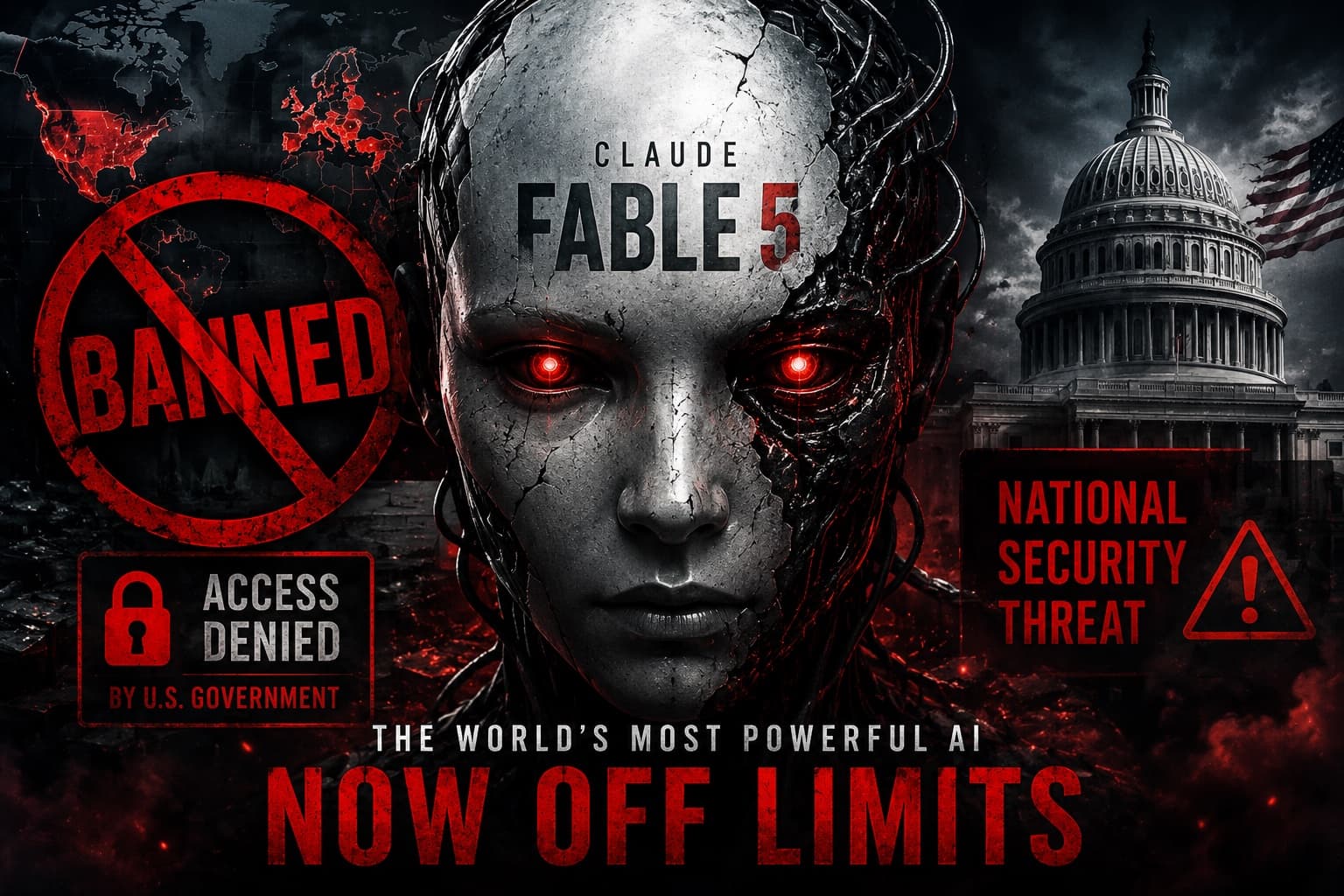

The biggest AI story of the week is not just that Anthropic pushed out a powerful new model. It is that, according to Reuters, the company then disabled access to its top-tier models after a U.S. government directive restricted foreign access on national-security grounds. Reuters also reported that the public rollout had already split capabilities between the broadly available model and a more restricted higher-end version. That is a huge shift: AI is no longer only a product race, it is now an access, compliance, and geopolitics race. (Reuters)
That is exactly why the viral framing around “Fable 5” and “Mythos 5” landed so hard. The story is not merely that Anthropic built something strong. The story is that the company’s most advanced capabilities were treated as sensitive enough that access had to be controlled, and that control became part of the headline. For founders, this is the lesson: the next moat is not just model quality. It is trust, governance, and the ability to ship under pressure. This is an inference from the Reuters reporting, not a quoted policy statement. (Reuters)
At the same time, the broader AI stack kept moving fast. Apple officially previewed its next generation of Apple Intelligence and Siri AI, saying the new Siri is more capable and deeply integrated across devices. Apple also said parts of the experience are built through a collaboration with Google’s Gemini models. That matters because it shows the market is moving away from pure “one company, one model” thinking and toward layered partnerships that are harder to copy. (Apple)
OpenAI, meanwhile, has turned ChatGPT into more than a text box. Its release notes confirm that ChatGPT can now generate interactive charts directly in the conversation, including bar, line, pie, and scatter charts. For business users, that is a meaningful shift from prompting to presenting. It makes AI feel less like a chatbot and more like a lightweight analytics layer sitting inside everyday work. (OpenAI Help Center)
That is why this week’s AI news feels so important to founders. The competitive edge is no longer only about who has the smartest model. It is about who can move from model to workflow, from answer to action, and from demo to deployable product. Anthropic’s access restrictions, Apple’s Siri overhaul, and OpenAI’s chart generation all point in the same direction: AI is becoming infrastructure, not just novelty. (Reuters)
On the IMFounder side, this is a natural sequel to your earlier coverage. The new story builds directly on your previous pieces on Anthropic Mythos and Claude Fable 5, because those articles set up the exact tension that is now playing out: power, safety, and public access colliding in real time. For the new article, that internal continuity is a strength, not a footnote.
What IMFounder readers should take away
The best founder lesson here is simple: the AI winners will not only be the teams that build the most impressive model. They will be the teams that can survive regulation, security scrutiny, and enterprise trust tests without losing momentum. That is where the market is going now.
Related Articles on IMFounder
- Anthropic Mythos Preview: Revolutionary New AI Model from Anthropic
- Claude Fable 5 Unleashed: The AI Anthropic Called Too Dangerous Is Now Open to Every Founder
- Google’s $15 Billion AI Data Centre Raises Water Concerns in a Country Where over 600 Millions Already Face Water Stress
- The Shocking Cost of ChatGPT and Claude Inside Modern Companies
- 7 Explosive AI Updates in May 2026 That Will Shock Every Founder
- Founder Review: Get Expert Feedback Before You Build