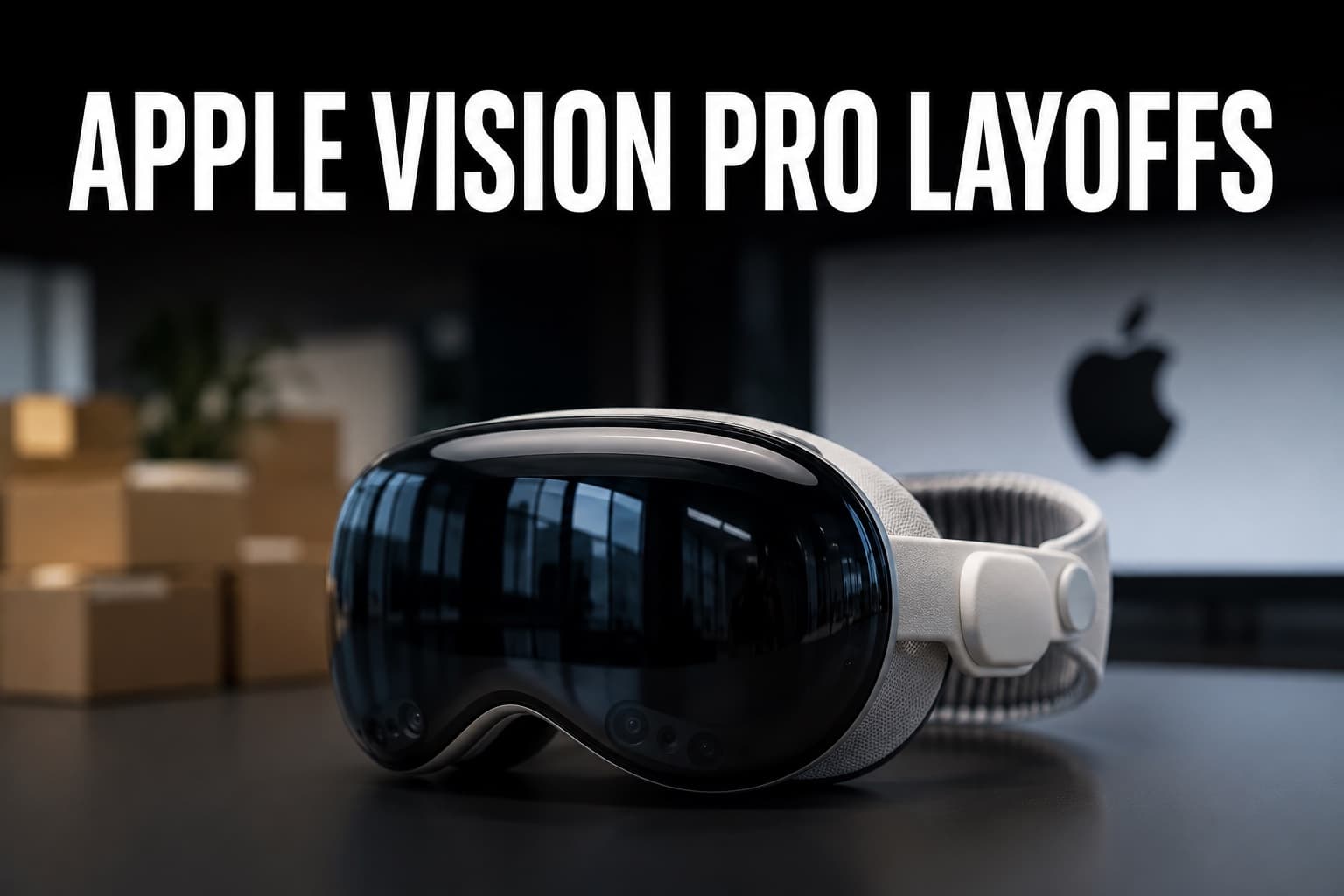

Apple reportedly cuts Vision team as the company shifts its future toward smart glasses and AI
Focus Keyword: Apple Vision Pro layoffs
Apple Vision Pro layoffs are now raising a much bigger question than how many employees lost their jobs: has Apple quietly changed its mind about the future of VR?
Reports emerging in August 2026 suggest that Apple has cut employees connected to its Vision Products Group, including at least 60 people tied to VR development, according to AppleInsider. Later reporting indicated that Apple’s broader restructuring affected more than 200 employees across Vision Pro, Siri and software teams, with approximately 100 of those positions connected to Apple’s Vision organization.
That distinction matters.
The viral claim spreading online — that Apple has completely cancelled Vision Pro and fired an entire division — goes further than the available evidence supports. Apple has not publicly announced the end of Vision Pro or visionOS. In fact, the company’s strategy appears more complicated and potentially more significant: Apple may be reducing its commitment to expensive, enclosed VR headsets while redirecting talent and investment toward AI, Siri and smart glasses.
For the employees affected, the news is immediate and personal. For Apple, however, these Apple Vision Pro layoffs may represent one of the most important strategic resets since the company launched the $3,499 headset.
The Vision Pro was supposed to introduce Apple’s next computing platform. Instead, less than three years later, Apple appears to be asking whether the future of spatial computing should actually sit on your face at all.
Apple Vision Pro Layoffs: What Has Actually Been Reported?
The first major report came from AppleInsider, which said that Apple had laid off at least 60 employees associated with VR development, the Apple Vision Group and related positions. The report described an entire team dedicated to VR development as being affected.
That immediately triggered headlines claiming Apple had abandoned Vision Pro.
But the situation appears more nuanced.
AppleInsider itself said the Vision Products Group had not necessarily been completely disbanded and that work on future Vision Pro technology and smart glasses could continue. Other reporting has since suggested a larger restructuring, with more than 200 Apple employees affected across multiple divisions.
The Vision Products Group reportedly took around 100 of those cuts. Areas affected included Vision Pro gaming and Apple’s expensive immersive video efforts.
Apple reportedly told affected employees that the company was realigning teams and would create new roles, while also eliminating some existing positions. Employees were reportedly encouraged to apply for other roles within the company.
That is not the same thing as Apple shutting down spatial computing.
But it is clearly not business as usual either.
The Bigger Problem: Vision Pro Never Became a Mass-Market Product
Apple Vision Pro was one of the most technically ambitious products Apple has ever released.
It combined ultra-high-resolution displays, advanced cameras, eye tracking, hand tracking, spatial audio and Apple’s M-series silicon into a device capable of blending digital interfaces with the physical world.
The technology was extraordinary.
The problem was everything surrounding it.
At launch, the Vision Pro carried a $3,499 starting price in the United States. For most consumers, that placed the product far beyond impulse-buying territory. Even many Apple enthusiasts struggled to justify spending the price of a high-end laptop and a vacation on a first-generation headset.
Then there was the hardware itself.
The Vision Pro was powerful, but it was still a headset. Users had to wear a substantial piece of technology on their face. Battery life was limited. Long sessions could become uncomfortable. The device was often described as impressive during demonstrations but difficult to integrate into everyday life.
Apple also faced a problem that has haunted nearly every VR platform: what is the killer app?
Watching movies on a giant virtual screen is impressive. Working with floating windows is futuristic. Spatial photos and videos can be emotionally powerful.
But were these experiences compelling enough to make millions of people wear a headset every day?
The market appears to have answered: not yet.
Apple has never publicly released Vision Pro sales figures, making it impossible to know the exact commercial performance. However, reports about weak adoption, reduced production expectations and a shrinking product roadmap have consistently suggested that Vision Pro did not become the breakout platform Apple may once have envisioned.
The Apple Vision Pro layoffs now add another visible signal that Apple is reassessing the category.
Why Apple Is Moving Toward Smart Glasses
The most important part of this story may not be the layoffs.
It may be where Apple is moving the money and talent next.
Reports from Bloomberg and analysts tracking Apple’s supply chain indicate that the company is increasingly focused on AI-powered smart glasses. Rather than asking consumers to wear a heavy computer headset, Apple could eventually place cameras, microphones, speakers and artificial intelligence inside something much closer to ordinary eyewear.
That has a dramatically larger potential market.
A $3,499 headset is a specialist product.
A pair of stylish smart glasses costing a few hundred dollars could potentially reach millions of people.
The success of Meta’s AI glasses strategy has also demonstrated that consumers may be more willing to accept wearable technology when it looks and feels relatively normal.
Apple’s reported smart glasses strategy is expected to be deeply connected with artificial intelligence and Siri. The glasses could use cameras and environmental awareness to understand what users are looking at, while AI handles questions, commands and contextual assistance.
That represents a fundamentally different vision from Vision Pro.
Vision Pro attempted to bring users inside computing.
Smart glasses could attempt to bring computing into everyday life without taking users out of it.
And that may be why Apple’s priorities are changing.
John Ternus and the Reported Vision Strategy Reset
The timing of the Apple Vision Pro layoffs is particularly interesting because Apple is approaching a major leadership transition.
Reports earlier in 2026 said that Apple’s future CEO, John Ternus, had been involved in approving a significant overhaul of Apple’s Vision roadmap.
According to analyst Ming-Chi Kuo, Apple’s previously broader pipeline of head-mounted products had been dramatically reduced. Reports suggested that plans for a second Vision Pro and a cheaper, lighter “Vision Air” had been cancelled or significantly changed.
However, Bloomberg’s Mark Gurman has offered a more nuanced view.
Gurman has reported that Apple may still be working on future Vision Pro technology, even if the category is effectively “on ice” for now. A lighter and cheaper successor could eventually emerge, but not before late 2028 or potentially 2029.
That creates an important distinction:
Vision Pro may not be dead. But it is no longer Apple’s immediate priority.
Smart glasses appear to have moved to the front of the queue.
The Apple Vision Pro Layoffs Also Reveal a Content Problem
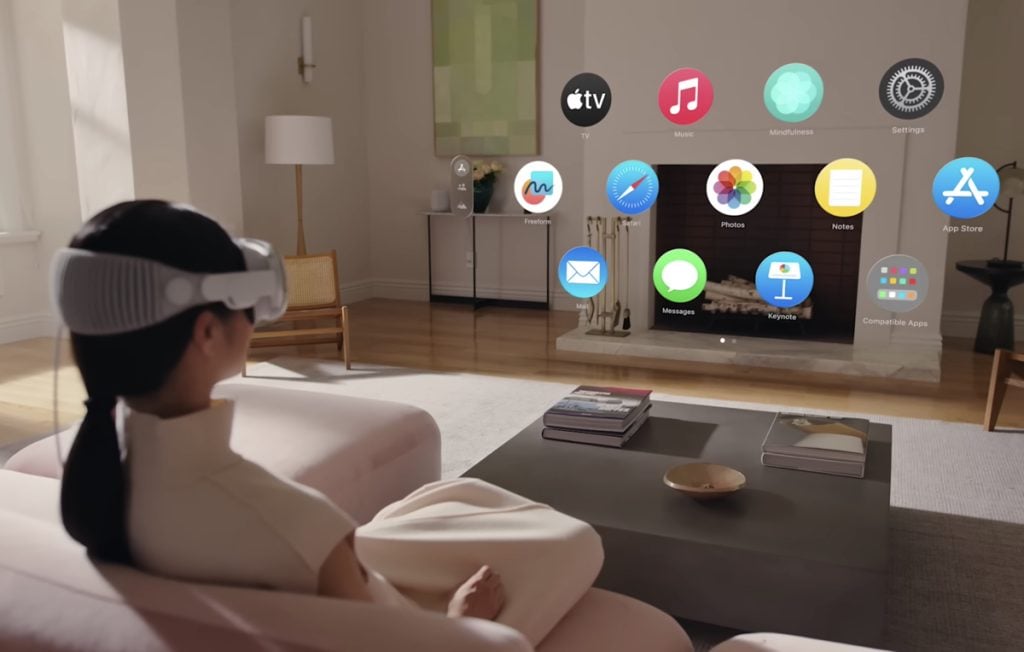
One of the most revealing details in the latest reporting concerns immersive video.
Apple invested heavily in creating premium immersive content for Vision Pro. These videos demonstrated what spatial entertainment could look like when filmed specifically for Apple’s headset.
The results were often spectacular.
But spectacular production is expensive.
Reports suggest that immersive content can cost millions of dollars to produce while reaching a relatively small audience of Vision Pro owners. That creates a difficult business equation.
Why spend enormous amounts producing content for a platform with a limited installed base?
Apple reportedly plans to reduce some of its internal immersive production and rely more heavily on third-party developers and creators.
The same issue appears to affect gaming.
A major new computing platform normally needs developers to create software people cannot get anywhere else. But developers are reluctant to invest heavily when the user base is small. Consumers, meanwhile, may hesitate to buy hardware when there are not enough applications.
That is the classic platform chicken-and-egg problem.
The Apple Vision Pro layoffs suggest Apple may be reducing its direct investment in solving that problem itself.
Apple Is Not Leaving Spatial Computing Behind
Despite the alarming headlines, declaring Vision Pro dead would currently be inaccurate.
Apple continues to maintain visionOS. The technologies developed for spatial computing are also valuable beyond the Vision Pro headset itself.
Computer vision, eye tracking, hand tracking, spatial interfaces, cameras and environmental intelligence can all become building blocks for future Apple products.
In other words, even if Apple eventually stops making Vision Pro-style headsets, the billions of dollars spent developing the underlying technology would not necessarily be wasted.
Those technologies could migrate into:
- AI-powered smart glasses
- Future augmented reality glasses
- AirPods with advanced environmental awareness
- iPhone camera intelligence
- Siri and visual AI systems
- Spatial interfaces across Apple’s ecosystem
That may be the most important way to understand Apple’s strategy.
The headset may change.
The technology may survive.
Why This Matters More Than a Typical Layoff Story
Technology companies restructure constantly. Teams are hired, moved, merged and eliminated.
But the Apple Vision Pro layoffs are different because Vision Pro was supposed to represent Apple’s next major computing era.
Apple had spent years developing the platform.
The company presented Vision Pro as the beginning of “spatial computing.”
It was not simply another accessory.
It was Apple’s attempt to answer a question Silicon Valley has been asking for more than a decade: what comes after the smartphone?
The answer may now be changing.
Apple’s experience with Vision Pro appears to have reinforced a difficult reality: consumers may want more computing, more AI and more digital assistance, but they do not necessarily want to wear a large computer on their faces.
Smart glasses offer a potentially easier transition.
They can be worn outside.
They can look like ordinary glasses.
They can capture photos, answer questions, play audio and use AI without isolating users from the world around them.
That is a much easier consumer story to sell.
The Real Lesson for Apple
Apple’s greatest strength has never been inventing technology first.
It has been taking emerging technology and turning it into a product ordinary people actually want.
The Macintosh did not invent personal computing.
The iPod did not invent digital music.
The iPhone did not invent the smartphone.
Apple’s challenge with Vision Pro is that it may have delivered an extraordinary piece of technology before the market was ready for the product.
The hardware was ahead.
The price was high.
The software ecosystem was limited.
The everyday reason to wear it was unclear.
That does not mean spatial computing failed.
It means the first form factor may have been wrong for the mass market.
Is Apple Vision Pro Cancelled?
The short answer is: there is no confirmed evidence that Apple has permanently cancelled the entire Vision Pro product category.
What is clear is that Apple’s plans have changed.
The cheaper Vision Air project appears to have been cancelled or shelved. Reports conflict on the exact status of a future Vision Pro successor, but multiple reports indicate that the category has been deprioritized while Apple focuses on smart glasses and AI.
The Apple Vision Pro layoffs reinforce that strategic shift.
Apple appears to be reducing investment in some areas of VR, including gaming and internally produced immersive content, while redirecting resources toward products with potentially broader consumer appeal.
That is a retreat.
But it is not necessarily a surrender.
The Bottom Line
The Apple Vision Pro layoffs should not be reduced to a misleading social media headline claiming that Apple killed Vision Pro and fired everyone working on it.
The reality is more complicated — and arguably more important.
At least 60 Vision-related employees were reportedly laid off in the initial AppleInsider report, while later reports described broader cuts affecting more than 200 Apple employees and roughly 100 positions connected to Vision products.
Apple has not announced that Vision Pro or visionOS is being shut down.
However, the direction is unmistakable.
Apple is becoming less aggressive about expensive VR headsets and more aggressive about AI, Siri and smart glasses.
The company that once showed us a future filled with floating windows and immersive digital worlds may now be betting that the next computer will be far less visible.
Not a headset that shuts out reality.
A pair of glasses that quietly understands it.
And that could make the Apple Vision Pro layoffs the moment when Apple’s spatial computing dream didn’t end — it simply changed shape.
Related Articles on IMFounder
- Apple Upcoming Products: The Secret Roadmap Revealed
- Apple Price Hike 2026: 7 Brutal Tech Increases Destroying Wallets Worldwide
- Apple OpenAI Lawsuit Exposes Shocking Trade Secret Betrayal
- Apple years of delays, Apple Finally Unleashes Siri AI
- 9 Explosive WWDC 2026 Leaks That Reveal Apple’s Biggest AI
- Apple’s “Unbreakable” M5 Chip Was Cracked by an AI in Just 7 Days
- AI Updates May 2026 That Shocked the Tech Industry
- Google’s $15 Billion AI Data Centre Raises Water Concerns in a Country Where over 600 Millions Already Face Water Stress