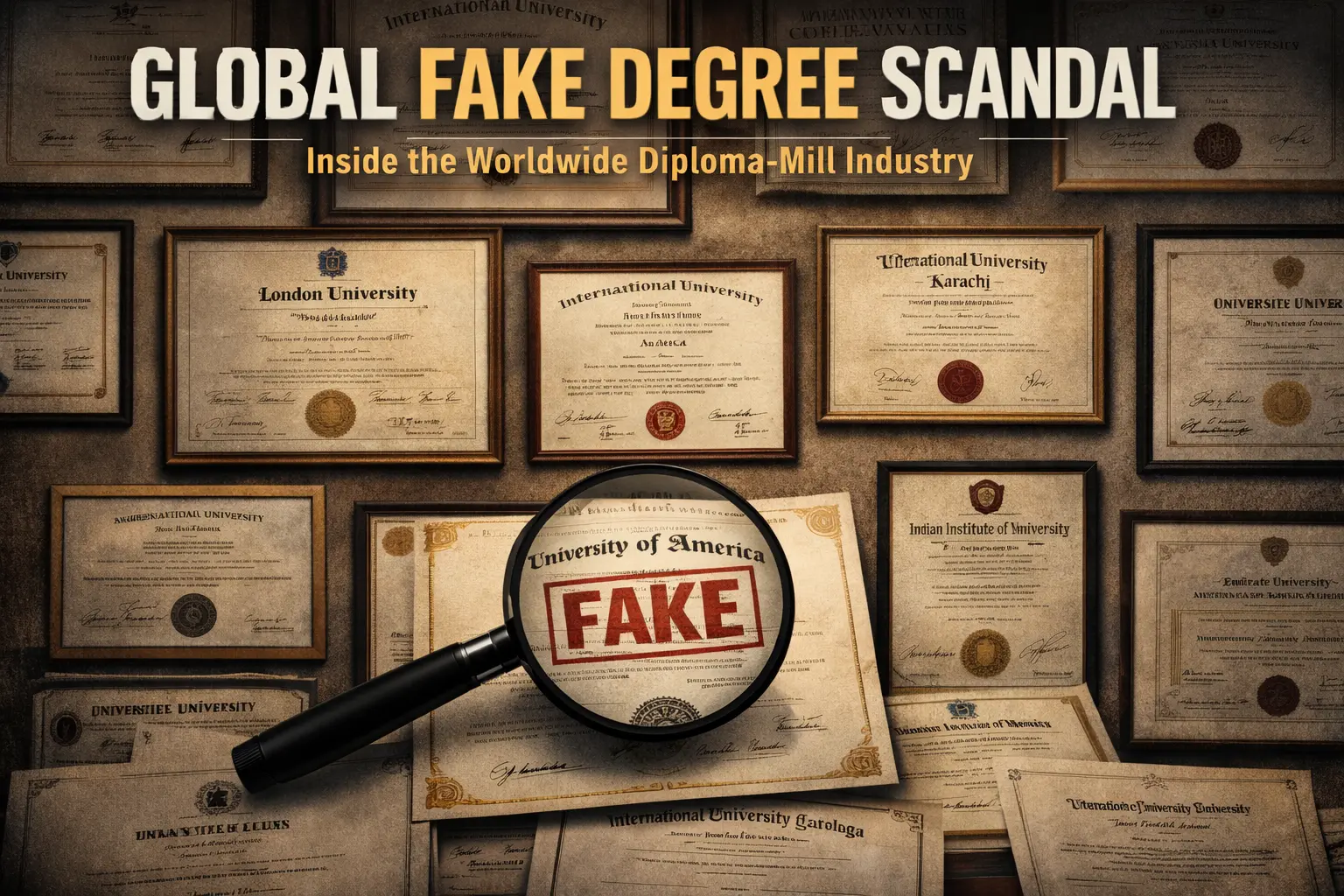

In a world where academic credentials often determine career opportunities, immigration pathways, and professional credibility, a shadow market for fake degrees has quietly expanded across continents. Investigations over the past decade have exposed fraudulent universities, forged diplomas, and large-scale diploma-mill networks operating in multiple countries.
From thousands of fraudulent nursing diplomas in the United States to global online diploma mills linked to Pakistan, education regulators and law-enforcement agencies have repeatedly warned that fake academic credentials are a growing international problem.
United States: Thousands of Fake Nursing Diplomas
One of the most serious education fraud cases in the United States emerged in 2023 during a federal investigation known as Operation Nightingale.
The investigation, announced by the U.S. Department of Justice, uncovered a scheme involving several Florida-based nursing schools that issued fraudulent diplomas and transcripts.
Authorities said that between 2016 and 2021, more than 7,600 fake nursing diplomas were sold to individuals who had not completed the required education or clinical training.
According to federal prosecutors, buyers typically paid $10,000 to $17,000 for the documents. With the diplomas and transcripts, many applicants were able to register for the NCLEX national nursing licensing exam, which allowed some to obtain professional licenses in multiple states.
More than 25 individuals were charged in connection with the scheme.
Sources:
- U.S. Department of Justice press release (2023)
- Texas Board of Nursing investigation reports
- Medical Economics reporting on the federal case
The scandal raised major concerns about patient safety and regulatory oversight, as investigators warned that some individuals who obtained licenses through fraudulent credentials may have worked in healthcare facilities.
India: Dozens of Fake Universities Identified
India has faced persistent issues with unauthorized institutions issuing degrees without legal recognition.
The country’s higher-education regulator, the University Grants Commission, regularly publishes warnings about fake universities operating in different states.
According to the UGC, 32 fake universities were identified across India as of 2026, many of them operating in major cities such as Delhi.
These institutions typically claim university status without authorization and advertise quick degrees in fields such as business administration, engineering, and doctoral programs.
Students who enroll often discover that the degrees are not recognized for employment, government jobs, or further education.
Sources:
- University Grants Commission (UGC) official notices
- India Today education reports on fake universities
- NDTV coverage of UGC warnings
Education authorities have repeatedly cautioned students to verify accreditation before enrolling in any institution.
Pakistan: The Axact Diploma-Mill Network
Perhaps the most globally extensive fake-degree operation came to light in 2015 when an investigation by The New York Times revealed the activities of Axact.
The investigation alleged that Axact operated hundreds of online universities that appeared to be legitimate American or British institutions.
These websites offered:
- bachelor’s degrees
- master’s degrees
- doctoral degrees
- professional certifications
Customers were often charged thousands of dollars for diplomas, transcripts, and verification documents.
The investigation reported that the company ran an international network selling degrees to buyers across North America, Europe, the Middle East, and Asia.
Pakistani authorities later arrested several executives connected to the company.
Sources:
- The New York Times investigative report (2015)
- Pakistani law-enforcement proceedings and court records
The case highlighted how easily fake academic institutions could operate online while targeting international buyers.
United Arab Emirates: Employment Fraud Cases
Authorities in the United Arab Emirates have also uncovered cases where job applicants submitted fraudulent academic credentials.
The UAE Ministry of Education has warned about fake foreign degrees used for employment applications in both the public and private sectors.
Investigations revealed that some individuals had purchased degrees from diploma-mill websites and attempted to use them to secure jobs.
To combat the problem, the UAE introduced strict degree attestation and verification procedures, requiring applicants to authenticate foreign academic credentials through official government channels before employment.
Sources:
- UAE Ministry of Education announcements
- Gulf News reporting on credential verification policies
United Kingdom: Diploma Mills Targeting International Students
The United Kingdom has also faced problems with diploma mills using names that resemble legitimate universities.
Regulators such as the Quality Assurance Agency for Higher Education have warned about fraudulent institutions claiming British accreditation.
Some of these organizations sell fake MBAs or postgraduate degrees online and market them to international students seeking qualifications associated with the prestige of UK universities.
Authorities have worked to identify and shut down such institutions while educating employers about credential verification.
Sources:
- UK Quality Assurance Agency warnings
- BBC and higher-education sector reporting
A Growing Global Industry
Education experts say the spread of fake degrees reflects a combination of economic and technological factors.
Several forces drive the industry:
- Global demand for credentials required for employment or immigration
- Online diploma mills capable of selling degrees worldwide
- Weak or fragmented regulatory oversight in some jurisdictions
- Credential inflation as more jobs require formal education
The result is a shadow market that investigators say generates millions of dollars annually.
Why Credential Verification Matters
Fake degrees undermine trust in higher education and can place unqualified individuals in sensitive professions such as healthcare, engineering, or finance.
Governments, universities, and employers are increasingly relying on credential-verification systems and accreditation databases to combat the problem.
But as recent scandals show, the global market for fraudulent degrees continues to evolve alongside legitimate education systems.