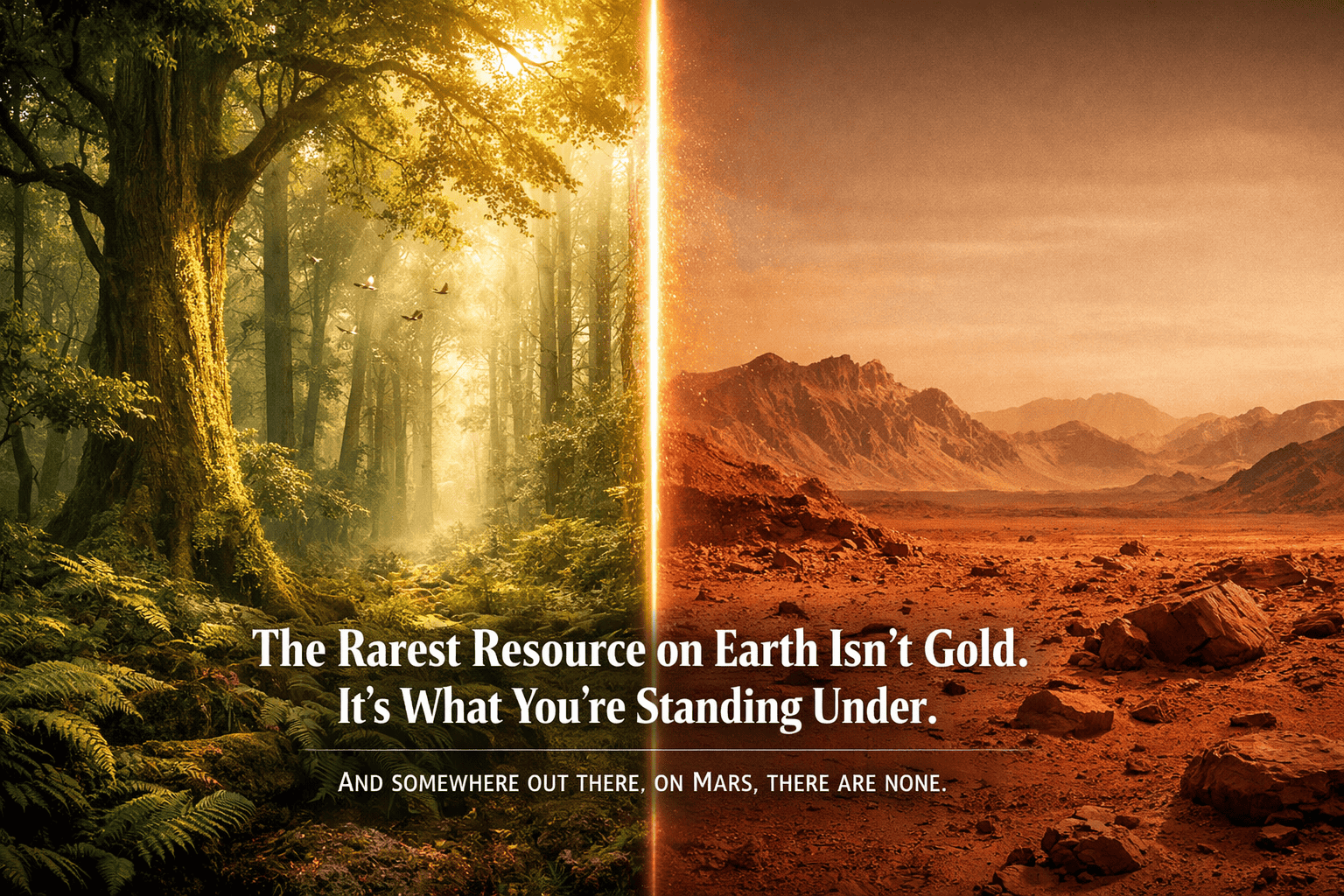

The rarest resource on Earth isn’t gold. It isn’t oil. It isn’t even fresh water. It’s the thing you probably walked past this morning without a second glance — a tree.
We’ve scanned distant galaxies. We’ve landed rovers on Mars. We’ve mapped the surfaces of moons circling Jupiter. And in all of it — every photograph, every soil sample, every spectrographic reading from billions of kilometres away — we have found exactly zero trees.
Not one.
Let that land for a second.
Why Trees Are Truly the Rarest Resource on Earth
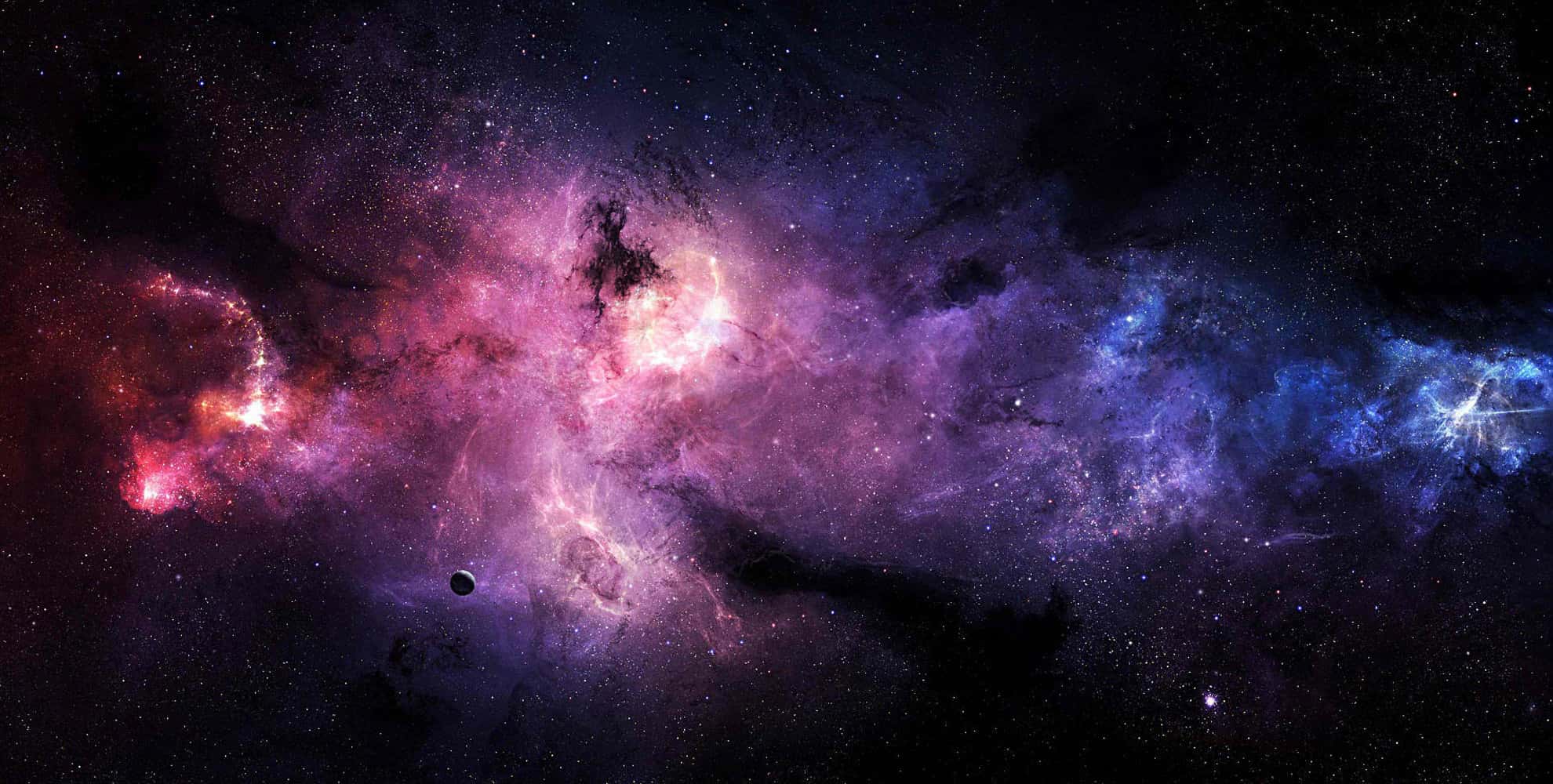
Gold forms in neutron star collisions and rains across the universe. Diamonds crystallize inside Neptune. Iron is the sixth most abundant element in the known cosmos.
But a tree? A tree needs photosynthesis, soil microbiomes, liquid water, a breathable atmosphere, billions of years of biological evolution, and a living ecosystem to even begin to exist.
No other material we call “precious” asks for that much.
That makes trees — quietly, cosmically — the rarest resource on Earth and in the entire observable universe. And yet, we’re cutting them down at a rate of roughly 15 billion trees per year, according to research published in Nature.
Fifteen billion. Per year.
1. A Tree Takes Decades. A Chainsaw Takes Seconds.
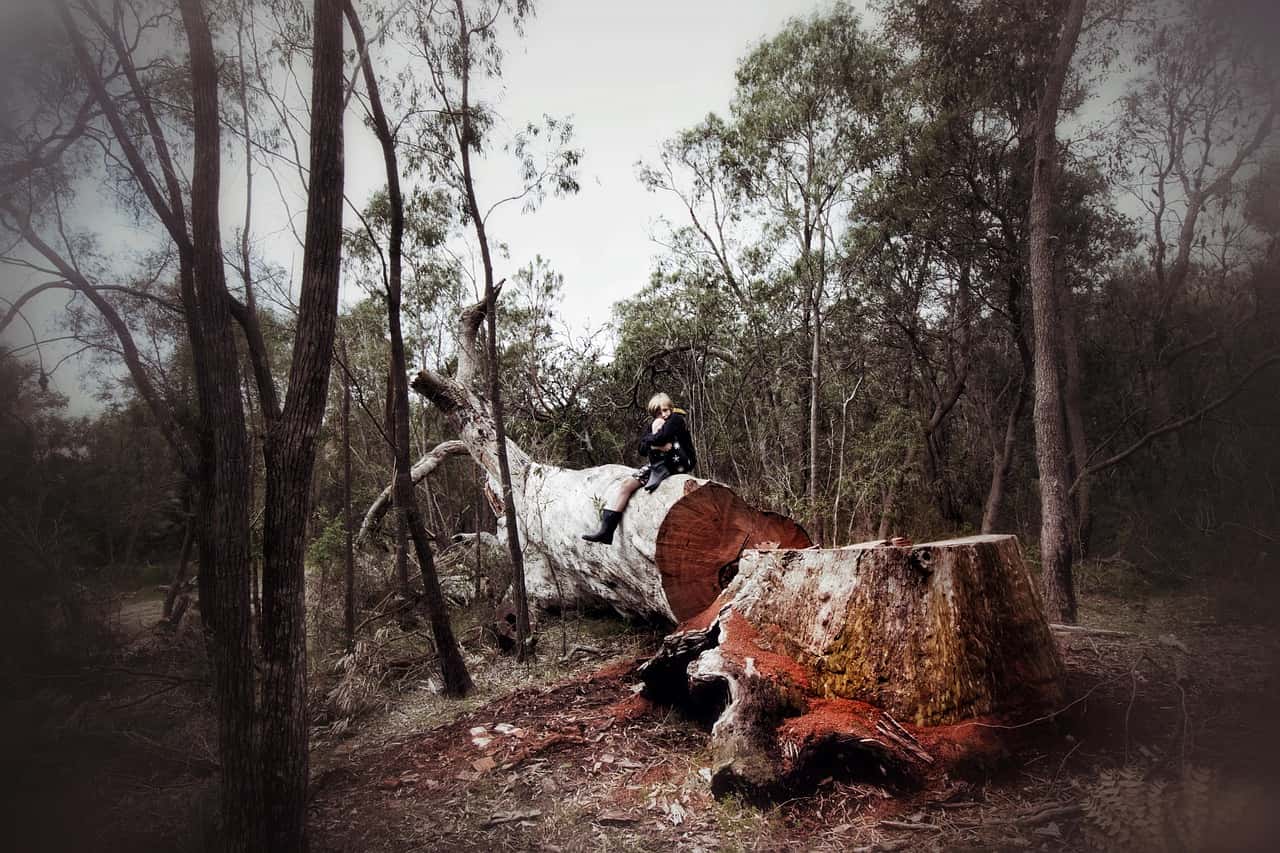
An oak tree takes 80 to 100 years to reach full maturity. A Douglas fir: up to 500 years. A redwood can live for 2,000 years — it was alive when the Roman Empire fell, when the first compass was invented, when Shakespeare was born.
It dies in under a minute.
There is no other resource on Earth where this destruction-to-creation ratio is so catastrophically lopsided. You can mine gold, melt it, reshape it — the gold still exists. You burn a forest, and centuries of biological complexity are gone. Permanently.
This is what founders and systems thinkers call a non-recoverable failure point. You don’t get a second chance at a 500-year-old forest.
2. Trees Are the Only Resource That Can’t Be Found Anywhere Else in the Universe
Here’s the perspective shift that should genuinely unsettle you.
Every mainstream “precious” material — silver, platinum, titanium, even diamonds — has been confirmed to exist beyond Earth. Asteroids are so rich in metals that space mining startups are already raising capital to extract them. NASA’s Psyche mission is currently en route to a metal-rich asteroid estimated to contain more iron-nickel than all of Earth’s reserves combined.
Trees? Nowhere. Not on the Moon. Not on Mars. Not on any of the 5,000+ exoplanets we’ve confirmed.
If you had to list every material exclusive to planet Earth — this one address in a universe of 200 billion galaxies — trees would be at the top of that list. The rarest resource on Earth is, by definition, also the rarest resource in existence.
3. The Mars Question Nobody Is Asking
Let’s get curious here for a moment — and this is worth sitting with.
We talk about Mars colonisation as if it’s an exciting frontier. Elon Musk wants a self-sustaining city there within decades. NASA has roadmaps. Startups are designing habitats.
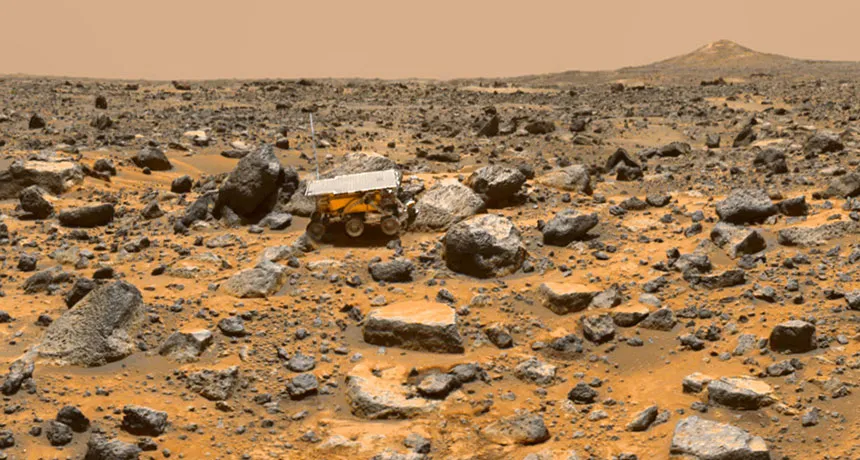
But here’s what nobody puts in the headline: Mars has no trees. Mars has no soil biology. Mars has no oxygen cycle.
And trees are the backbone of all three.
Could we grow trees on Mars? Theoretically, perhaps — inside pressurised biodomes, with engineered soil, artificial light, and precisely controlled atmosphere. Research into space agriculture is real and advancing. But we’re talking about extraordinary, fragile, resource-intensive systems just to replicate what Earth does automatically, for free, across billions of acres.
We are destroying on Earth what we would spend trillions trying to recreate on Mars.
If that doesn’t generate at least a little existential pause, read it again.
4. Trees Are Infrastructure, Not Decoration
Here’s where founders especially need to reframe this.
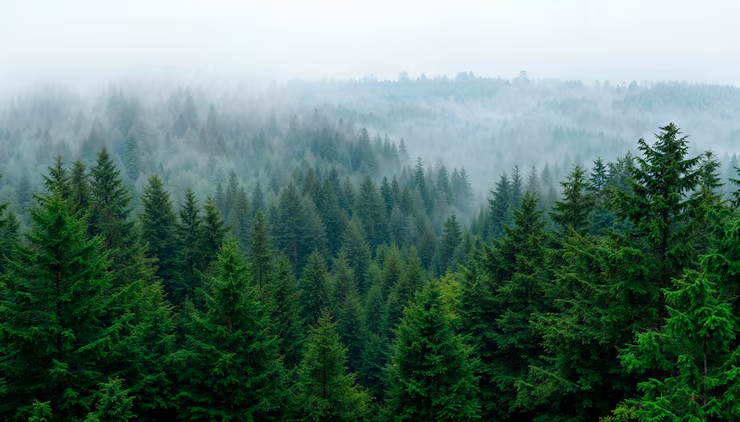
We don’t think of trees as infrastructure — but they are. They are the original operating system of Earth’s livability.Remove them and the system crashes:
- No trees → no oxygen replenishment
- No trees → accelerated soil erosion → agricultural collapse
- No trees → disrupted water cycles → droughts and floods intensify
- No trees → CO₂ unchecked → temperatures rise → feedback loops accelerate
The World Resources Institute estimates that deforestation contributes approximately 10% of global carbon emissions annually. That’s not a footnote. That’s a civilisation-level variable.
We wouldn’t rip out the electrical grid of a city “because we needed the copper.” But functionally, that’s what deforestation does to Earth’s life support systems.
5. The Rarest Resource on Earth Has No Synthetic Substitute
We’ve synthesized diamonds. We’ve lab-grown meat. We manufacture materials that didn’t exist in nature. Human ingenuity is genuinely extraordinary.
But nobody has built a synthetic tree.
You cannot factory-produce a 200-year-old rainforest canopy. You cannot 3D-print the fungal networks — the “wood wide web” — that connect trees underground and allow forests to communicate and share nutrients. You cannot replicate, at scale, what a living forest does for rainfall, temperature, biodiversity, and atmospheric balance.
The rarest resource on Earth is irreplaceable. Not “hard to replace.” Irreplaceable.
That’s not a metaphor. That’s ecology.
6. We Treat the Irreplaceable as Disposable
Here’s the cultural failure at the core of this.
We have entire financial markets protecting gold. We have international law protecting cultural heritage sites. We have vaults in Norway preserving seeds against extinction.
Yet, an ancient tree — a living organism older than most nations — can be legally cut down for a parking lot.
We’ve built elaborate systems to preserve things that the universe has plenty of. And we’ve built almost nothing to protect the one thing the universe has nowhere else.
It’s one of the most spectacular misalignments of value in human history. And it’s ongoing, right now, at 15 billion trees per year.
For more on how founders and leaders are rethinking resource stewardship, explore our IMFounder lifestyle section — where we cover the intersections of innovation, nature, and long-term thinking.
7. The Window Is Open — But Not Forever
Here is the final thought, and it’s both sobering and urgent.
We are, right now, living in the only moment in human history where the choice still exists. Forests can still recover — if given the chance. Reforestation works. The Trillion Trees initiative and similar programs have demonstrated that large-scale forest restoration is scientifically viable and economically achievable.
But the window is not infinite.
Forests past a tipping point don’t slowly decline — they collapse. The Amazon, the lungs of the planet, is approaching a dieback threshold according to leading climate scientists. Once crossed, it doesn’t recover on any human timescale.
We are the first generation to fully understand this. We may be the last generation with the leverage to change it.
And that — more than any market crash, any geopolitical shift, any technological disruption — is the defining founder challenge of this century: how do you build a future on a planet whose operating system you’re deleting?
Final Thought: The Rarest Resource on Earth Deserves a Rarer Kind of Respect
Gold will be found on asteroids. Metals will be mined from space. Energy will be harvested from stars.
But if we lose Earth’s forests, no Mars colony, no space mission, no technological leap will bring them back on any timeline that matters to human civilization.
The rarest resource on Earth grows quietly. It gives oxygen without asking. It holds soil together while we sleep. It has been here for hundreds of millions of years before us.
And right now, it needs us to simply stop.
Start seeing trees not as scenery — but as the most irreplaceable infrastructure on the only living planet we know of. Because that’s exactly what they are.
Want more perspectives at the intersection of innovation, nature, and the future? Explore IMFounder’s lifestyle and culture coverage for founders who think long-term.
Related Articles on IMFounder
- How Sysco Corporation Consolidated the Middle Layer of Food Distribution — Becoming the Infrastructure Behind Restaurants
- Hair Fall & Shower Water: Causes, Prevention, and Technology — Hard Water, Hair Loss, Prevention Tips & Best Shower Filters Explained
- Most Popular Holiday Drinks in North America — including hot chocolate, mulled wine, peppermint mocha, and eggnog
- Best Places for Stunning Fall Foliage — Top Road Trips & Hidden Gems for Peak Fall Colors in North America
- The Rise of Streetwear in North America: From Subculture to Mainstream — Culture, Brands & Future