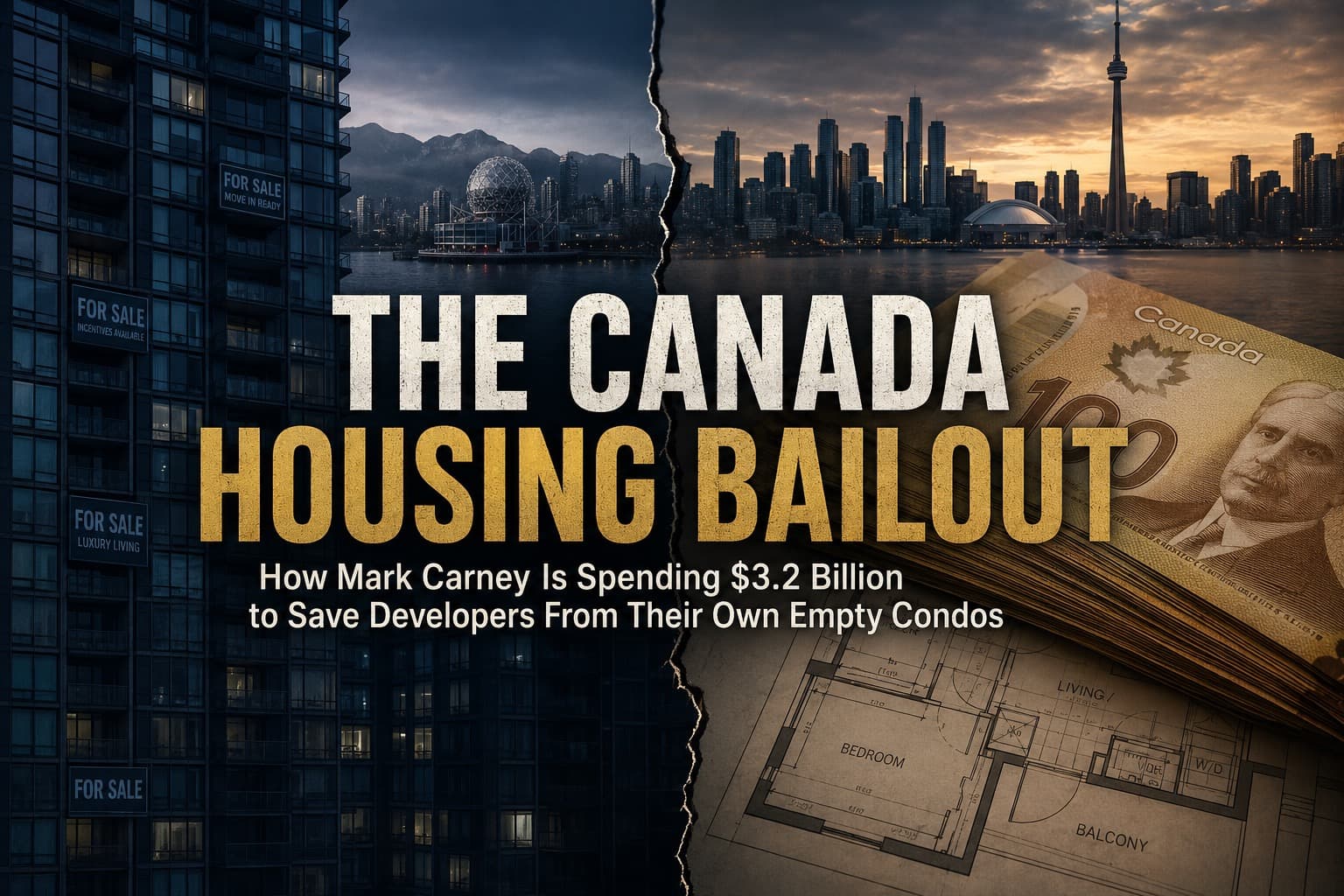

The Canada housing bailout is no longer a theory — it’s a $3.2 billion reality, and it has split the country. In June 2026, Prime Minister Mark Carney stood beside British Columbia Premier David Eby in Vancouver and announced that Ottawa and the province would step in to buy more than 2,200 completed but unsold condo units, converting them into affordable and rent-to-own housing. Supporters called it a smart use of empty inventory. Critics called it something else entirely: a bailout for the same developers who spent a decade betting Canadian real estate would never stop climbing.
This is the story of how that bet went wrong, who is now paying for it, and what it means for the ordinary Canadians who were never invited to the table.
What Is the Canada Housing Bailout, Exactly?
At its core, the Canada housing bailout is a government purchase program. Ottawa and British Columbia plan to acquire more than 2,200 vacant, newly built condo units in Metro Vancouver, using a package that includes roughly $3.2 billion in spending over ten years, cuts of up to 50 percent to development charges in priority zones, and “innovative financing” tools to help developers offload inventory they cannot sell at the prices they want.
The trigger was a glut nobody could ignore. According to Canada Mortgage and Housing Corporation data, Metro Vancouver had 4,376 completed condos sitting empty as of last month — a 76 percent jump from a year earlier. Toronto’s numbers are worse in raw volume: market analyst Urbanation recorded a record 4,295 completed but unsold condos in the Greater Toronto Area in the first quarter of 2026, more than double the total from a year prior.
Carney has defended the plan as a response to developers who, in his words, cannot afford to sit on empty units indefinitely while also being unwilling to sell at a loss. The government’s position is that converting stalled inventory into affordable housing solves two problems — vacancy and affordability — in one move.
Why Critics Call It a Bailout, Not a Fix
The word “bailout” is doing a lot of work in this story, and it isn’t coming from one side of the aisle. Conservative Leader Pierre Poilievre described the plan as a wealth transfer that forces ordinary taxpayers to effectively bid against themselves in a market the government itself helped inflate. Former BC Conservative leader John Rustad went further, framing the intervention as propping up developer mistakes rather than letting the market correct itself.
Economist Mike Moffatt, founding director of the Missing Middle Initiative at the University of Ottawa, offered a more measured take: whether this is a genuine housing win or a disguised bailout depends entirely on price. If the government pays close to full market value for units it wasn’t already planning to buy, he argued, that is a bailout in every meaningful sense. If it forces developers into steep discounts on projects that already existed, the math looks very different.
That distinction matters because, as of publication, neither Ottawa nor Victoria has released the actual purchase price per unit. Estimates from independent analysis put the potential cost between $1 billion and $1.4 billion just for the condo acquisition, on top of renovation costs to convert market-rate units into affordable housing — leaving open the possibility that developers could see a windfall in the billions if units are bought near peak pricing.
The Human Cost Behind the Headlines
Government press conferences rarely show the people actually living through a housing correction, but the pattern is familiar to anyone who has followed Canada’s pre-construction condo market over the past two years. As we detailed in our earlier investigation into how the housing bubble burst for real buyers, Toronto-area buyers who signed pre-construction contracts during the 2020–2022 boom have been forced into an impossible choice: close on units now worth $150,000 to $300,000 less than their contract price, or walk away and forfeit deposits that in many cases exceeded $100,000. One Toronto-area townhome, according to that reporting, resold for nearly $200,000 less than its 2016 purchase price — despite one of the biggest housing booms in Canadian history happening in between.
That is the backdrop against which the current bailout debate is unfolding. The people who lost six figures on pre-construction deposits received no government rescue package. The developers who overbuilt into a market that stopped absorbing new supply are now being offered one. Online reaction to the announcement has reflected that frustration directly, with residents in Vancouver and Toronto publicly accusing the government of protecting corporate losses while first-time buyers continue to be priced out entirely.
Why Canadian Housing Was Vulnerable to This in the First Place
None of this happened in a vacuum. As we explored in our earlier deep dive on why homes are so much more expensive in Canada than in the U.S., Canada’s housing market has long been shaped by restrictive zoning, slow permitting, heavy taxation, and a construction industry that never scaled fast enough to match population growth. Those structural issues created exactly the kind of speculative, supply-starved market where a boom could turn into an unsellable glut almost overnight once interest rates rose and investor demand cooled.
In other words, the current condo overhang in Vancouver and Toronto isn’t a random shock. It’s the predictable output of a market that spent a decade rewarding speculation over supply — and now taxpayers may be asked to absorb the cost of unwinding it.
What Happens Next
The full terms of the Canada housing bailout — including exact purchase prices, which developers are involved, and how “affordable” will be legally defined for the converted units — are expected to be finalized in the coming months. Housing economists interviewed by national outlets have said the program’s legacy will be decided entirely by those details: bought at a discount, it could genuinely add affordable supply; bought near full price, it risks becoming a permanent case study in privatized gains and socialized losses.
For now, the emptiest condo towers in the country remain exactly that — empty, expensive, and at the center of a national argument about who gets protected when a housing market cools.
Related Articles on IMFounder
- Real Stories of Buyers Who Lost Hundreds of Thousands
- Why Are Homes So Expensive in Canada Compared to the U.S.?
- The Canadian Real Estate Bubble: Rising Prices, Slow Corrections, and the Quest for Affordable Housing.
- Mamdani Luxury Home Tax Proposal Targets Luxury Second Homes Over $5 Million
- The Best Coworking Spaces for Founders in Canada in 2026
Sources:
Urbanation Q1 2026 Greater Toronto Area condo inventory report, CBC News — analysis of the BC condo bailout plan, Global News — Carney’s response to developer bailout criticism, Canada Mortgage and Housing Corporation (CMHC) vacancy and market data