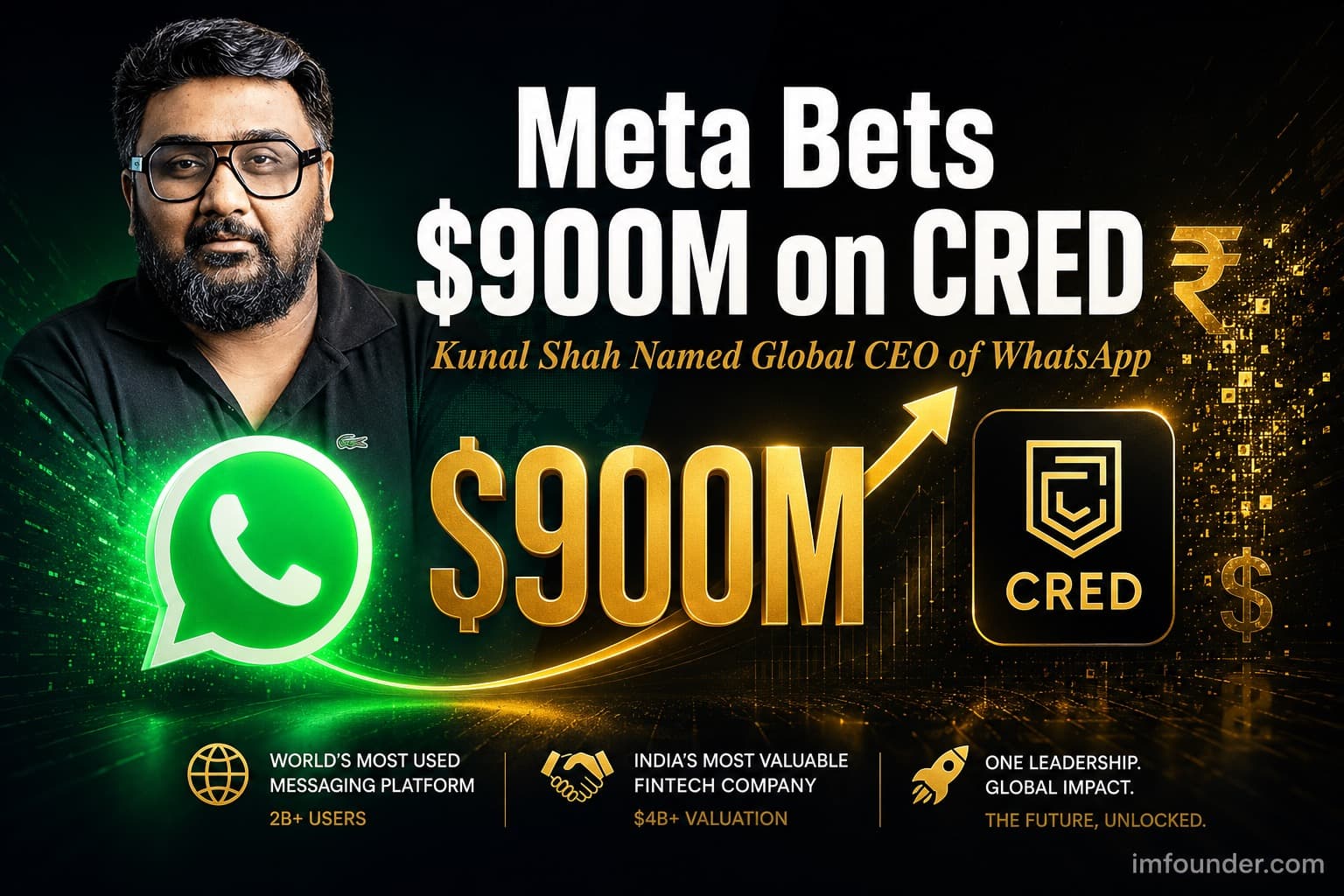

Meta CRED Kunal Shah WhatsApp — four words that just rewrote the rules of global tech. On June 22, 2026, Mark Zuckerberg’s Meta Platforms detonated one of the most explosive dual announcements in Silicon Valley history: a $900 million investment into Indian fintech startup CRED, paired with the appointment of its founder, Kunal Shah, as the new global head of WhatsApp. This wasn’t just a hiring headline. This was a declaration of war on the future of digital payments, commerce, and AI-driven messaging — and India is the battleground.
If you think you’ve seen this movie before, you haven’t. This is a story about ambition, timing, and a bet so large it could reshape how 3 billion people on earth send money, pay bills, and buy things — all from a single chat window.
What Exactly Happened: The Meta CRED Kunal Shah WhatsApp Deal, Explained
Let’s start with the facts. According to TechCrunch, Meta led a Series H financing round of approximately $900 million in CRED, the Bengaluru-based fintech platform. The deal, structured through a mix of primary capital injection and secondary share purchases, gives Meta a roughly 20% minority stake — valuing CRED at $4.5 billion post-money, up from $3.6 billion in May 2025.
Critically, Meta does not receive a board seat, and the deal explicitly excludes access to CRED’s customer data. But the simultaneous leadership move is what makes this truly historic: Kunal Shah steps down as CRED’s CEO — with Miten Sampat taking over as interim chief — and joins Meta full-time to replace Will Cathcart, who led WhatsApp for nearly seven years. Cathcart transitions to a new AI-focused product-building role within Meta.
This is not a coincidence. This is a calculated masterpiece of a strategic move.
Who Is Kunal Shah? The Man at the Centre of the Meta CRED WhatsApp Story

Before you can understand why Meta made this move, you need to understand the man at the centre of it.
From Mumbai’s Middle Class to Silicon Valley’s Most Wanted
Kunal Shah was born in Mumbai into a modest Gujarati family — his father ran a small wholesale pharmaceutical business. He studied philosophy at Wilson College in Mumbai, briefly enrolled in an MBA at NMIMS, and dropped out. No computer science degree. No IIT pedigree. No MBA from a brand-name school. What he had instead was an obsessive curiosity about human behaviour, money, and trust.
He started working in his teens, held multiple roles through the 2000s, and in 2009 founded PaisaBack, a cashback promotions company. That pivot became FreeCharge in 2010 — a digital payments platform co-founded with Sandeep Tandon that rewarded mobile recharges with discount coupons. In 2015, Snapdeal acquired FreeCharge for approximately ₹2,800 crore (~$400–450 million) — one of the biggest startup exits India had seen at the time.
Building CRED: The Trust Machine That Caught Zuckerberg’s Eye
After the FreeCharge exit, Shah didn’t retire to a beach. In 2018, he launched CRED — a members-only rewards platform that pays India’s creditworthy consumers (credit score above 750) to pay their credit card bills on time. The concept sounds almost too simple. That’s what makes it genius.
CRED now processes over 40% of India’s credit card bill payment volume, commands 17 million monthly active users, and reported operating revenue of ₹2,735 crore in FY25 while dramatically cutting losses to ₹298 crore. Beyond CRED, Shah has backed more than 250 startups as an angel investor — including Razorpay and BharatPe — making him one of India’s most influential startup ecosystem builders.
His June 2026 WhatsApp appointment marks the first time an Indian startup founder has been handed the global leadership of a flagship product at one of the world’s largest technology companies.
Meta’s Chief Product Officer Chris Cox sent Kunal Shah a cold email seeking advice on who should lead WhatsApp. By the end of the call, Cox had found his answer. What followed was a three-month process — multiple visits to Meta’s California HQ and dinner at Mark Zuckerberg’s home — that ended with Shah accepting the role.
Why Meta Invested $900M in CRED: Person or Platform?
Here’s the question the entire tech world is asking: Is this an investment in CRED, or an investment in Kunal Shah? The answer is both — and that’s precisely the point.
1. WhatsApp Has a Payments Problem It Cannot Ignore
India is WhatsApp’s largest market with over 500 million users. Yet WhatsApp Pay held just 0.65% of India’s UPI transaction volume as of May 2026 — in a country that processes over 23 billion UPI transactions every month. Meta had already invested $5.7 billion in Jio Platforms in 2020 to accelerate WhatsApp commerce through JioMart. The needle barely moved. This is a crisis of conversion, not distribution — and Shah is India’s foremost expert on solving exactly that problem.
2. The “Acqui-Hire in a Minority Stake Disguise” Pattern
Independent analyst Shanaka Anslem Perera described the deal as “an acqui-hire wearing a minority stake as a disguise.” The pattern echoes Meta’s 2025 playbook: Meta invested over $14 billion in Scale AI and simultaneously brought founder Alexandr Wang inside Meta to lead its AI efforts. Two deals. One repeatable pattern. Buy minority equity. Hire the founder. Gain strategic insight and operational talent without triggering a full acquisition’s regulatory heat.
3. CRED’s RBI Payments Aggregator Licence Is Strategic Gold
CRED recently received Reserve Bank of India authorisation to operate as a payments aggregator — one of the most difficult regulatory approvals in Indian fintech. Shah arrives at WhatsApp with a licensed financial infrastructure asset already in hand. Meta doesn’t need to build the regulatory foundation from scratch. It’s hiring the person who already built it.
4. India Generates Over $1 Billion a Year for WhatsApp
Business messaging is WhatsApp’s primary revenue engine, and India reportedly contributes more than half of WhatsApp’s global earnings — over $1 billion annually. WhatsApp’s paid messaging business crossed a $2 billion annual run rate in Q4 2025. The stakes for getting India’s next chapter right are existential for Meta’s bottom line.
What Meta Is Building on WhatsApp: The Future Kunal Shah Will Shape
The Meta CRED Kunal Shah WhatsApp combination is not just about patching a UPI market share gap. The vision is far more ambitious.
WhatsApp as a Financial Operating System
Meta is positioning WhatsApp as a commerce and financial services super-app. The roadmap includes UPI payments, credit card processing, net banking, lending products, and insurance — all accessible directly inside a chat thread. In markets like India, Brazil, and Indonesia, where WhatsApp is already the primary interface of the mobile internet, this move transforms a messaging app into a bank branch in your pocket.
AI-Powered Business Messaging at Massive Scale
In May 2026, Meta launched its Business AI product for WhatsApp in India, enabling small businesses to automate customer queries and complete transactions in all native Indian languages — without code or third-party tools. WhatsApp also began rolling out AI-generated response drafts in March 2026. Shah is expected to radically accelerate this roadmap, combining his fintech product instincts with Meta’s AI infrastructure to convert conversations directly into commerce at scale.
The Super-App Ambition: Shop, Pay, Borrow, Bank — All Inside WhatsApp
Mark Zuckerberg has been unambiguous: WhatsApp’s next chapter is commerce. Under Shah, analysts expect concentrated investment in WhatsApp Business tools for merchants, deeper enterprise messaging infrastructure, and tight integration between payments, AI assistants, and conversational commerce. If Meta succeeds, the app already on 500 million Indian phones becomes the place where they do everything financial — not just chat.
The Honest Challenges: Why This Is Still a High-Stakes Gamble
No story this big comes without real friction.
The Market Share Gap Is Enormous
Closing the gap on PhonePe (47%+ of UPI) and Google Pay (37%+) requires deep merchant adoption, a payments habit shift for hundreds of millions of users, and credibility with regulators. That takes years, not months.
The Scale Paradox
CRED’s power came from its exclusivity — serving only India’s top creditworthy consumers. WhatsApp serves everyone, everywhere. Translating a premium, trust-first fintech model to a genuinely mass-market global product without losing its essence is the central product design challenge of Shah’s new role.
Global Leadership at Uncharted Scale
Shah will lead a product used by 3 billion people across 180 countries, touching enterprise clients, global regulators, and Western consumer markets simultaneously. His India expertise is beyond question. His experience managing this breadth of complexity is still to be written.
“This is not just a leadership transition — it is a product philosophy stress test. If Meta wants to turn WhatsApp into a stronger fintech and commerce engine, the challenge will be proving that scale in messaging can actually convert into scale in monetisation.” — Kaushik Moitra, Partner, Bharucha & Partners
The Bigger Signal: What the Meta CRED Kunal Shah WhatsApp Deal Means for Founders
Step back from the numbers and look at what this deal signals to every founder building in an emerging market today.
Big Tech is no longer just competing for users or products. It is now competing for founders who understand regulated, high-growth markets that Western engineers have never lived in. Zuckerberg didn’t hire a Stanford MBA or a polished Silicon Valley executive to fix WhatsApp’s India problem. He hired a Mumbai philosophy dropout who spent eight years building financial trust with Indian consumers from the ground up.
That is a story about the next decade of tech leadership — and what it actually looks like.
If you’re building in emerging markets: The Founder’s Playbook: Building Scalable Startups in India.
Final Verdict: Is the $900 Million Meta CRED Bet Worth It?
The investment thesis is sharp. India is WhatsApp’s biggest market, biggest revenue opportunity, and biggest unsolved problem simultaneously. Kunal Shah has built financial trust at scale in that market, twice, under completely different conditions. Meta is not buying a fintech company. Meta is buying a builder’s mind — and placing it at the centre of the world’s most-used messaging platform.
Whether Shah can translate CRED’s psychology-driven, trust-first model into WhatsApp’s mass-market global infrastructure — and whether he can move fast enough in a payments market dominated by deeply entrenched local giants — will define WhatsApp’s next decade.
One thing is already certain: the $900 million is the smallest part of this story. The real bet is what Kunal Shah builds next.
Follow imfounder.com for the deepest coverage of the founders, deals, and ideas reshaping the global startup world.
Related Articles on IMFounder
- Why Every Startup Suddenly Wants to Become an “AI Company”
- Startup Ideas Rejected by Investors That Became Unicorns
- How Zhong Shanshan Built a $70 Billion Empire Selling Bottled Water
- Startup Failure Rate 2026: Why 90% of Startups Fail
- Under-30 Founders to Watch in 2026
- Building Wealth While Building a Startup: The Financial Playbook