
Sakana Fugu AI just became the most talked-about AI model on the planet — and it didn’t come from Silicon Valley.
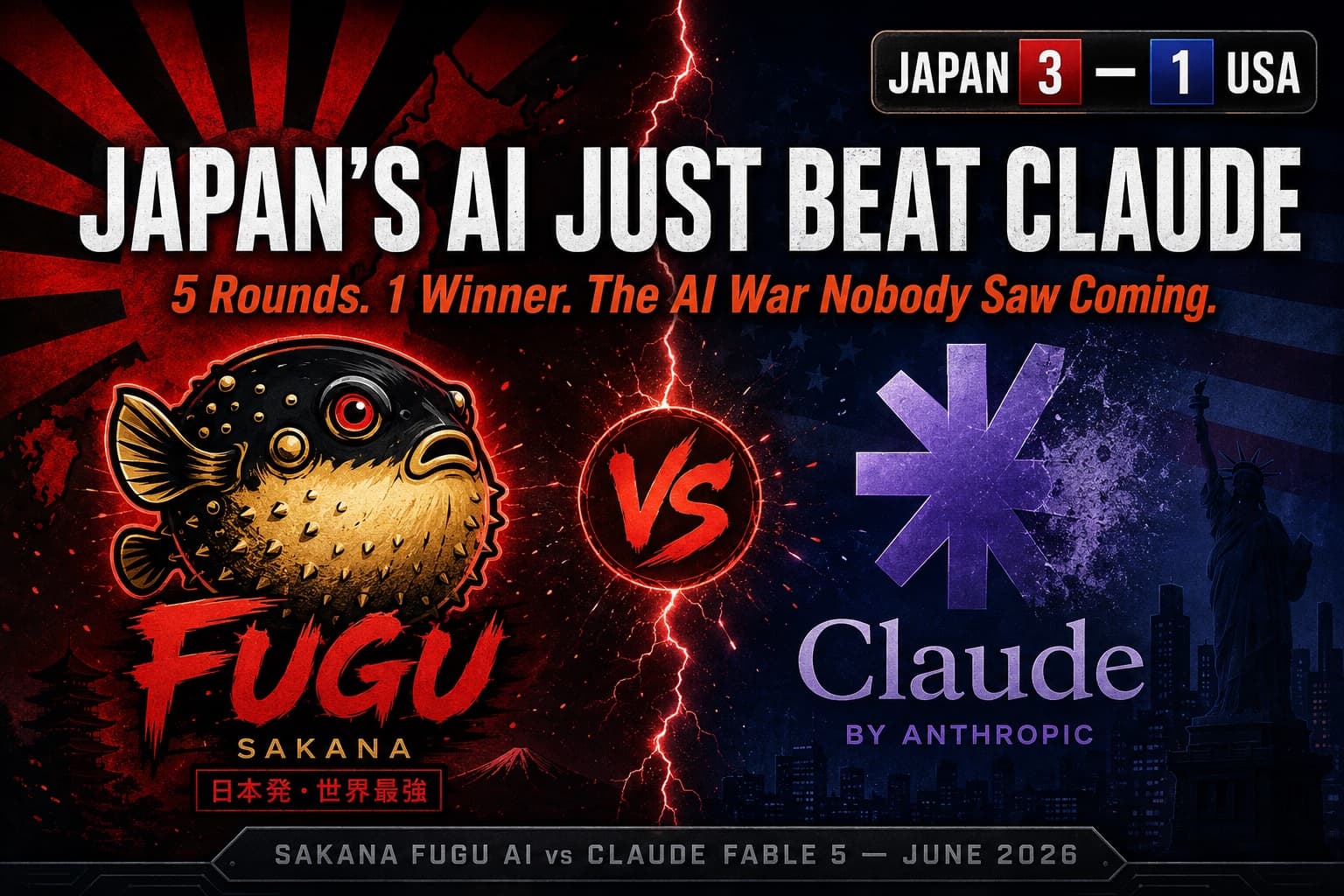
One week, America pulled Claude from global access. Four days later, Japan’s released Fugu, a multi-agent AI system that doesn’t just claim to compete with Claude — it walked into a five-round benchmark fight and won three of them. Cleanly.
Here is what happened, why it matters for founders and developers, and what this tells us about the shifting balance of power in the global AI race.
What Is Sakana Fugu AI — And Why Is It Different?
Every AI you have used before is essentially one brain answering your question. GPT, Gemini, Claude — they are all powerful, but they work alone.
Sakana Fugu AI doesn’t work that way.
Fugu is not really a model. It is a manager. Behind that single login sits a pool of the world’s most capable AI models — closed ones like GPT, Gemini, and Claude, plus a range of open-source alternatives. When you give Fugu a task, it doesn’t just pick one model. It picks the right specialists for the job, runs them in parallel, has them fact-check each other’s outputs, and hands you back one clean, finished result.
You are not chatting with an AI anymore. You are hiring a team that never sleeps — from a single sentence.
Why This Timing Is Geopolitical
The week Fugu launched is not a coincidence. Following U.S. restrictions on advanced AI model exports, the question the entire AI world started asking was simple: what happens if your government pulls the plug on the AI powering your business?
Fugu’s answer, in their own words: frontier capability without the risk of export controls.
Because Fugu does not rely on any single company’s model, there is no one plug a government can pull. That is the entire pitch — and for enterprises outside the United States, it is a powerful one.
Fugu vs Claude: 5 Rounds, Brutal Results
The benchmark test was simple: the same five prompts, tested on both Fugu and Anthropic’s Claude (Fable 5). No advantages for either side. Here is how every round played out.
Round 1 — AI Learning Roadmap: Fugu Wins 🇯🇵
Prompt: Build a single-file app that creates a personal AI learning roadmap.
Claude delivered a clean experience — one question at a time, a gentle flow, solid output. But Sakana Fugu AI presented all three questions on a single screen, generated a full 90-day plan instantly, and made every single node clickable inside an interactive skill tree. Real course links opened from inside the app, including live Kaggle lessons.
Faster, more visual, more useful in fewer clicks.
Score: Japan 1 — 0 USA
Round 2 — Build a 2D Run-and-Gun Game: Draw 🤝
Prompt: Build a 2D run-and-gun game in a single file.
Claude built “Jungle Strike” — smooth, playable, genuinely fun. Fugu built “Jungle Steel” — equally responsive, equally impressive, with an instant restart on death.
Side by side, both were remarkable from one sentence. Neither pulled ahead by a meaningful margin.
Score: Japan 1 — 0 — 1 USA (Draw)
Round 3 — Elite Design Consultant: Fugu Wins 🇯🇵
Prompt: Act like an elite design consultant. Tear this landing page apart and build me a better one.
This is where the multi-agent AI system architecture of Fugu started to show its real value. Before building a single line, Fugu wrote a complete professional design critique — covering visual hierarchy, WCAG accessibility standards, color contrast ratios, button typography, padding, and cognitive load. It thought exactly like a real senior consultant would.
Then it built the page — and the page was alive. Switching color themes from sand to silver to graphite updated the entire design in real time. It even built a fully working reservation checkout flow, with step-by-step navigation, directly inside the output.
Claude’s version was clean and minimal. On its own, it would impress. Next to Fugu’s version, it looked like a first draft.
Score: Japan 2 — 0 — 1 USA
Round 4 — Creative Website “One Wish Willow”: Claude Wins 🇺🇸
Prompt: Build a weird, creative interactive website for something called One Wish Willow.
Claude hit back hard. Its version had an antique, storybook aesthetic, a branch that cracked with a real sound effect on click, proper storytelling sections, genuine charm, and soul. The kind of output you screenshot and send to a friend.
Fugu’s version had brilliant copy — a headline that read “Amaze your friends. Alarm your future.” — and the interactivity was smart. But on overall polish and visual execution, Claude clearly won this round.
Credit where it is due.
Score: Japan 2 — 1 — 1 USA
Round 5 — Equity Research War Room: Fugu Knockout 🇯🇵
Prompt: Run a full equity research war room with an analyst, valuation expert, bull, bear, fact-checker, and judge — investigate a real listed company and hand me back a decision a normal human can understand.
This round was designed specifically to showcase what a multi-agent AI system can do that a single model cannot. With Fugu, you do not just get an answer. You watch the team go to work.
The analyst ran first. Then the valuation expert. Then the bull laid out the strongest case to buy. The bear argued the strongest case to run. The fact-checker called out the weak claims. The judge weighed everything and made the final call.
The output: a full interactive equity dashboard with live share price data, PE ratios, EV/EBITDA metrics, a business map showing exactly where the company makes its money, a side-by-side bull vs bear breakdown, and a scenario lab where dragging a slider recalculated every number on screen in real time — including the final verdict.
A human analyst would take two to five full working days to produce something like this. Sakana Fugu AI did it before the coffee went cold.
Final Score: Japan 3 — 1 — 1 USA
The Verdict: What Fugu’s Win Actually Means
This is not about Japan building a smarter model than Anthropic. Fugu does not have to be smarter — it orchestrates models that already are, across every task category, simultaneously.
The shift happening here is architectural. Single-model AI is not going away, but for complex, multi-step work — the kind that actually runs a business — multi-agent coordination is proving to be the next major performance leap.
As for cost: all five of those builds ran on a few dollars of API usage. Paid plans start at $20 per month.
The question stopped being: whose AI is the smartest? It is now: whose AI can’t be switched off?
Japan just answered that question.
What This Means for Founders and Developers
If you run a business that depends on AI for research, design, development, or decision-making, the Fugu architecture matters to you for three specific reasons:
- Resilience: No single model dependency means no single point of failure — including geopolitical ones.
- Output quality: Multiple models fact-checking each other’s work means fewer hallucinations and more finished, usable results.
- Speed: Tasks that used to take days of analyst time now take minutes of prompt time.
The founders who figure out how to integrate multi-agent AI workflows into their operations first are going to have a significant structural advantage over those who are still using a single chatbot window.
Related Articles on IMFounder
- 15 Explosive AI Updates June 2026
- AI Updates May 2026: What Every Founder Needs to Know
- Google AI May Be Killing the Open Internet
- Kimi AI vs Claude: 7 Brutal Truths Every Founder Must Know in 2026
- Anthropic Fable 5 Shockwave: Why the AI Arms Race Just Turned Geopolitical
- Why Canada’s Biggest AI Bet Could Be a Game-Changer for Founders and New Immigrants
- 7 Explosive AI Updates in May 2026 That Will Shock Every Founder