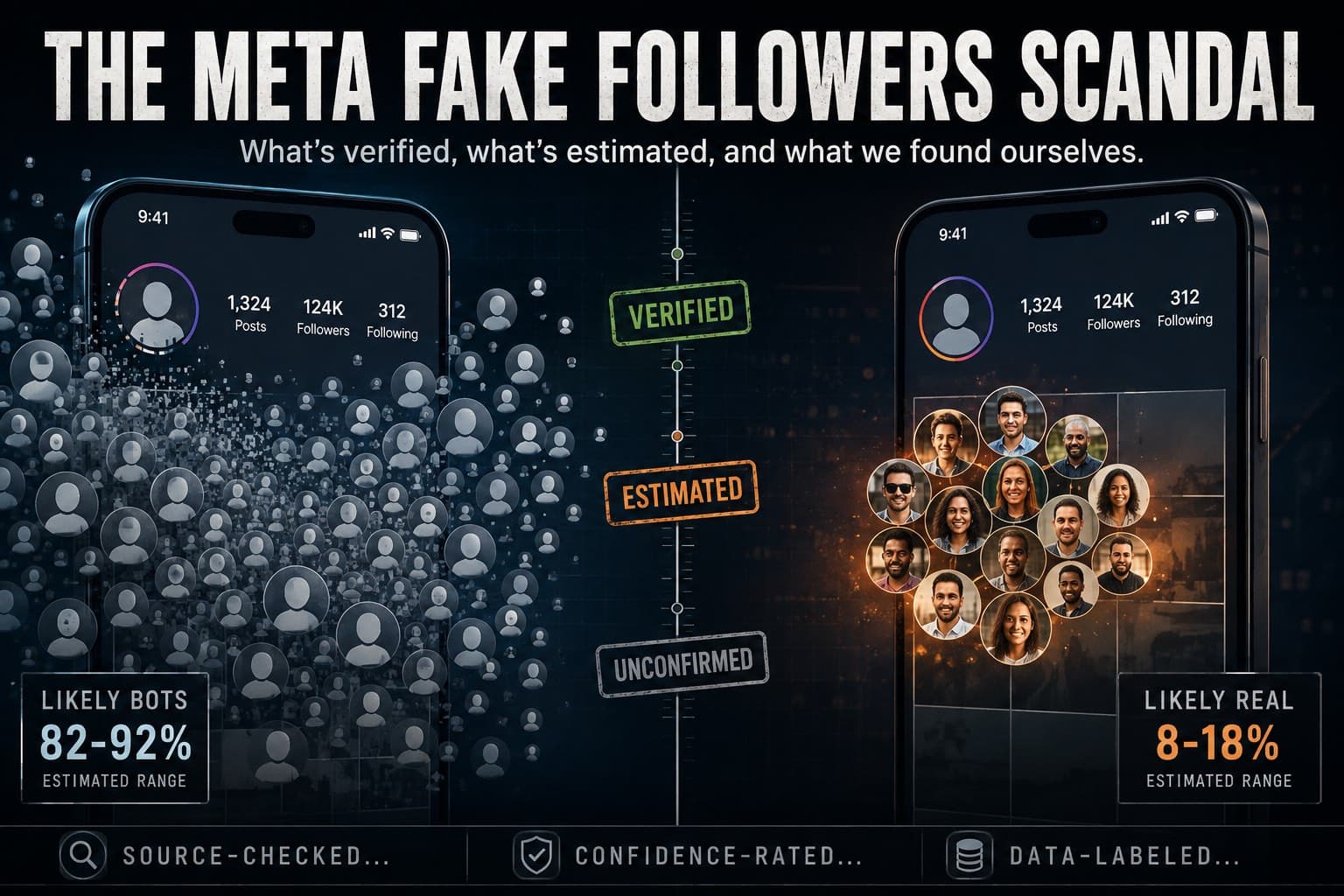

What’s Verified, What’s Estimated, and What We Found in Our Own Ad Test
The Meta Fake Followers Scandal is a real, documented pattern — but not every number attached to it carries the same weight. Some claims are confirmed by court settlements and Meta’s own disclosures. Others come from marketing-industry vendors with a commercial stake in the story. And some, including a headline number our own team generated, are simply one advertiser’s unverified test result.
This article separates all three, clearly, because that’s the only honest way to write about a topic this widely rumored and this poorly sourced elsewhere online. Every claim below is labeled: VERIFIED, INDUSTRY ESTIMATE, or UNCONFIRMED / OUR OWN TEST.
Our Own Test — Labeled as What It Is: UNCONFIRMED / OUR OWN TEST
We ran a small ad campaign on Facebook and Instagram and manually audited a sample of the accounts that liked, followed, and engaged with it. We are disclosing this transparently: this was not a controlled scientific study, it used a modest budget and a small sample, and it has not been independently replicated or peer-reviewed.
What we observed in our sample:
- The large majority of engaging accounts had no profile photo, no bio, and no meaningful post history.
- A sizeable share of accounts appeared to have been created shortly before engaging with our ads.
- Engagement came disproportionately from regions unrelated to our targeting.
- Almost none of the engaging accounts returned, commented, or showed any follow-up behavior after the initial like or follow.
Internally, our audit flagged roughly 95% of engaging accounts as low-quality or bot-like by these criteria. We want to be direct about the limits of this number: it reflects one campaign, one sample, and our team’s own manual criteria — not a certified fraud rate, and not proof of what happens on every Meta ad account. We’re sharing it as a data point and a starting point for the rest of this article, not as a definitive industry statistic.
What Is Actually Verified: The Documented History
These are matters of public record — court filings, company disclosures, or contemporaneous reporting from multiple outlets.
VERIFIED — The 2019 $40 million settlement. Facebook agreed to pay advertisers $40 million to settle claims that it had overstated average video-viewing metrics by as much as 900% over an 18-month period in 2015–2016. Court filings alleged internal discussions among Facebook employees about avoiding a public “no-PR” disclosure while the company worked out how to downplay the scale of the error. Facebook disputed the fraud claims and settled without admitting wrongdoing.
VERIFIED — The 1.3 billion fake-account disclosure. In 2019, Facebook disclosed it had removed approximately 1.3 billion fake accounts in a single three-month period, prompting watchdog groups to publicly question how much advertiser and taxpayer ad spend had gone toward reaching accounts that were never real.
VERIFIED — Meta’s own 2026 enforcement figures. Meta’s H1 2026 Adversarial Threat Report, published in March 2026, states the company removed more than 10.9 million Facebook and Instagram accounts in 2025 for violating policies against fraud, scams, and deceptive practices, and reports more than 87% of Instagram enforcement actions were initiated by Meta’s own systems rather than user reports. This is Meta’s self-reported data, not an independently audited figure — but it is an official company disclosure, not a rumor.
VERIFIED (widely reported) — The May 2026 “Great Purge.” A large-scale cleanup of bot and inactive accounts in May 2026 triggered visible follower losses for celebrities, influencers, and brands, including a drop of more than 14 million followers on one high-profile influencer’s account. Meta stated the newer AI detection tools driving this cleanup analyze text, images, and account behavior, and that most flagged accounts are blocked before any user complaint is filed.
UNCONFIRMED (worth flagging as a rumor, not a fact) — Instagram’s own account losing 9 million followers.The widely shared claim that Instagram’s own official account lost nearly 9 million followers during the same purge traces back to a viral post on X, not an official Meta statement. It’s repeated across several news aggregators, but it has not been independently confirmed by Meta or verified against platform data. We’re including it here specifically to flag it as unconfirmed, not to present it as fact.
What’s an Industry Estimate, Not a Verified Fact
Several numbers frequently cited in coverage of this topic come from marketing-industry vendors — companies that audit engagement or, in some cases, sell “real” followers as a service. Their data is useful directionally, but it is not independently verified research, and some of these vendors have a direct commercial interest in convincing readers that fake engagement is widespread.
INDUSTRY ESTIMATE — SociaVault Labs fraud rate. A 2026 analysis of 100,000 Instagram and TikTok accounts by SociaVault Labs reported a combined Instagram fraud rate of 41.8%, versus 32.6% on TikTok, with accounts in the 100,000–500,000 follower range showing the highest rate at 48.3%. The report itself discloses real limitations: an estimated 8–12% false-positive rate, a snapshot limited to February 2026, no coverage of private accounts or story interactions, and comment analysis optimized for English. Treat this as one vendor’s methodology on one dataset, not an industry census.
INDUSTRY ESTIMATE — Bot follower retention rates. Industry data cited by a 2026 engagement-purity report puts bot-sourced follower retention at 15–40% after 90 days, compared with 85%+ retention for accounts run by real people. This comes from a marketing analytics vendor, not a peer-reviewed source.
INDUSTRY ESTIMATE — Historical ad fraud dollar figures. Older, frequently recycled statistics — such as the oft-cited “$1.3 billion in ad fraud losses” — trace back to a 2019 CHEQ report. That figure is real but dated, predates several platform changes, and is regularly stripped of its original context when reused in 2026 content. A number of other widely circulated statistics in this space — such as “8.7 million profiles / 41.3% fraud” or “$4.8 billion in losses” — do not trace back to any accessible, citable publication from the vendors they are attributed to, and should not be repeated as fact.
Why the Verified History Matters More Than the Big Round Numbers
Strip away the vendor estimates and the unconfirmed viral claims, and the verified record still tells a clear story: Meta has, more than once, disclosed inflated or inaccurate metrics after advertisers had already spent money based on them (2019), and continues to remove tens of millions of fake or fraudulent accounts every year (2025–2026), using detection systems that act after an account has already engaged with paid content, not before.
That’s the part of the Meta Fake Followers Scandal that doesn’t depend on any single vendor’s fraud percentage. It’s simply the mechanics of how detection currently works: bot accounts engage with ads, get billed to the advertiser, and are removed later — sometimes in dramatic public purges like the one in May 2026, sometimes quietly.
Is This Deliberate Deception, or an Unsolved Enforcement Gap?
This is where the evidence runs out, and where honest reporting has to stop short of a conclusion the facts don’t support. The verified record shows:
- A documented instance (2019) where Facebook took over a year to disclose a metrics error it had internally identified.
- Large, real, and repeated volumes of fake-account removals disclosed by Meta itself.
- No verified evidence, in any of the sources above, that Meta deliberately manufactures or profits from bot engagement as a matter of current company policy.
Meta says its detection systems now catch the majority of fake accounts before a user ever files a complaint, and the scale of its 2025–2026 removals is real evidence of active enforcement, not silence. The more defensible criticism isn’t that Meta is secretly running a bot farm — it’s that detection consistently lags behind billing, and that advertisers, including our own small test, keep encountering the same gap tech journalists first documented years ago.
How to Protect Your Ad Budget, Regardless of Cause
Whether the gap is due to deliberate indifference or a genuinely hard technical problem at global scale, the practical response for advertisers is the same:
- Manually audit a sample of engaging accounts after every campaign — profile photo, bio, post history, and account age are quick signals.
- Watch engagement rate, not follower count. A healthy Instagram engagement rate in 2026 is generally cited in the 3–6% range by industry sources; anything close to zero on a large follower base is a red flag.
- Track retention, not just acquisition. Real engagement compounds over weeks; bot engagement typically flatlines immediately.
- Use narrow, specific ad targeting rather than broad “cheap engagement” campaigns, which are the segment most exploited by low-quality account farms.
- Compare your own manual audit against the platform’s dashboard summary, the way we did — don’t take the top-line number at face value.
- Report suspected bot engagement directly to Meta. Enforcement is real, if delayed, and user reports contribute to the data behind large-scale purges like the one seen in May 2026.
The Bottom Line
The Meta Fake Followers Scandal is real, but the strength of the evidence varies a lot depending on which number you’re looking at. The $40 million settlement, the 1.3-billion-account disclosure, and Meta’s own 2025–2026 removal figures are verified facts. The 41.8% fraud-rate estimate and similar figures are industry vendor research with disclosed limitations, not settled science. The claim about Instagram’s own account losing 9 million followers is an unconfirmed viral claim. And our “95%” figure is exactly what we’ve labeled it throughout: one small, unverified test from our own team.
Put together, the honest conclusion is this: fake and low-quality engagement on Meta’s platforms is a well-documented, recurring problem — not a myth, not new, and not solved. But the specific scale of it in any individual ad account is something every advertiser still has to check for themselves, because neither Meta’s dashboards nor any single vendor’s headline statistic can be taken at face value.
Have you audited your own Meta ad engagement? We’d like to compare notes — reach out to our editorial team, or explore more of our coverage on influencer fraud measurement and what “engagement rate” actually means for small business ads.
Source:
- Facebook $40M video-metrics settlement — Variety
- Facebook $40M settlement details — Hollywood Reporter
- Internal “no-PR” strategy allegations — Slate
- 1.3 billion fake accounts disclosure coverage — Pressreader/Arkansas Democrat-Gazette
- Meta H1 2026 Adversarial Threat Report coverage — UpGrow
- “Great Purge of 2026” reporting — National Herald
- Meta AI detection tools statement — AIN
Related Articles on IMFounder
- The Truth About AI Girlfriends & Digital Companionship
- A.I. Social Media Accounts Are Growing Faster Than Humans And It’s Changing Everything
- BBC Investigation Into Meta Instagram Child Abuse Ads Found
- How TikTok’s AI Algorithm Is Helping Small Businesses Scale Overnight
- CJP Protests Expose Education Crisis Under Modi Government
- 16 Countries Banning Kids From Social Media in 2026