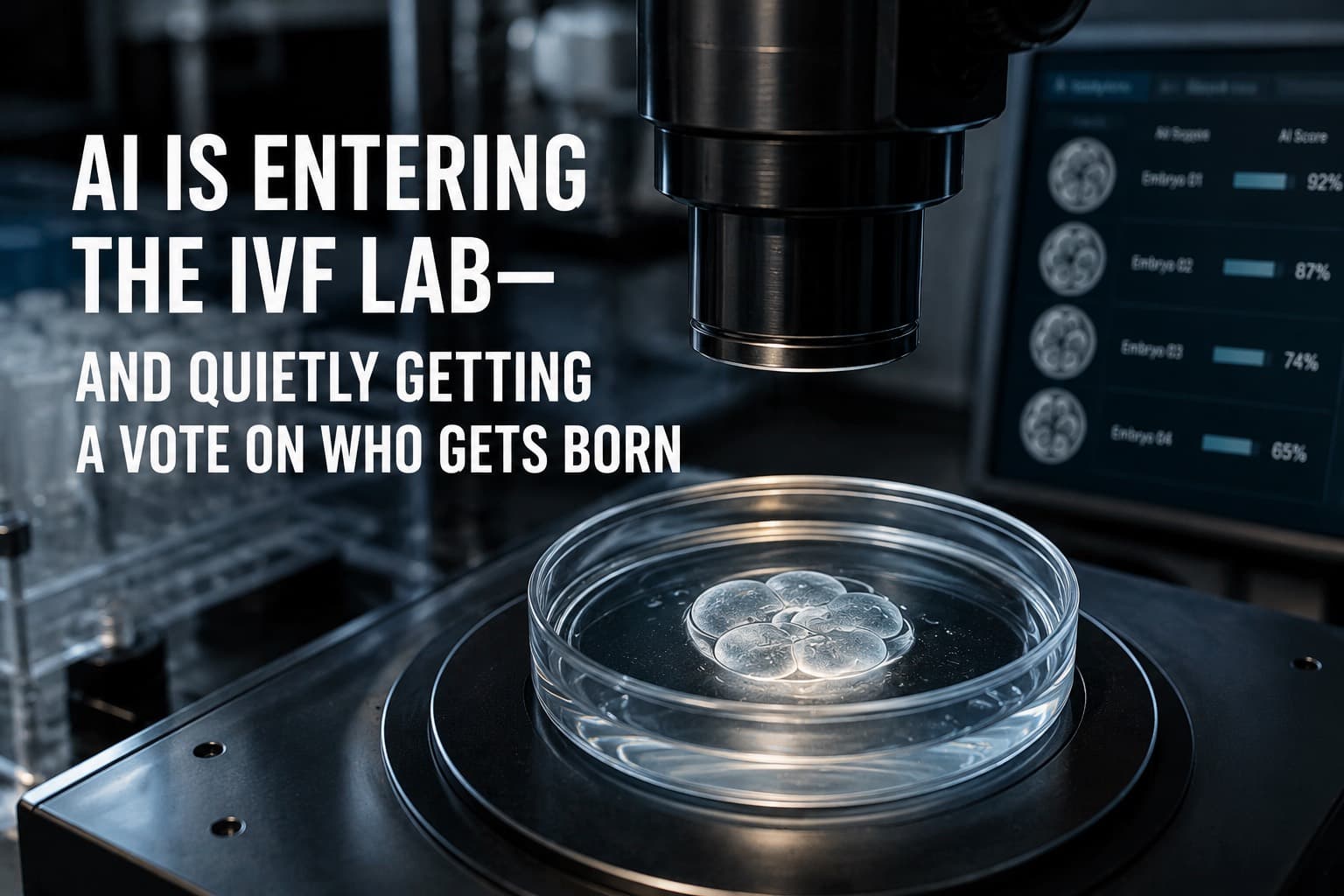

Embryologists have always decided which embryos appear most likely to become successful pregnancies. Now algorithms are learning to rank them, pushing reproductive medicine toward a question technology has never had the power to ask at scale: which potential human gets the first chance at life?
Inside an IVF laboratory, several embryos may be developing at the same time, each carrying the possibility of becoming a pregnancy and eventually a child. For decades, deciding which embryo should be transferred first has depended heavily on trained embryologists examining morphology: cell structure, developmental timing, fragmentation and the appearance of a blastocyst under a microscope. It is a consequential judgment made from biological evidence, clinical experience and standardized grading systems, but it is still a human judgment—and different embryologists do not always rank the same embryos in the same order.
Artificial intelligence is now entering that decision.
Modern time-lapse incubators can photograph developing embryos repeatedly without removing them from controlled culture conditions. Instead of evaluating a few snapshots, AI systems can analyze developmental sequences containing enormous amounts of visual information, extract morphological and temporal patterns and assign embryos scores associated with outcomes such as blastocyst formation, chromosomal normality, implantation, pregnancy or live birth. The embryologist remains responsible for the clinical decision, but another intelligence is increasingly sitting beside that decision, looking at the same potential human life and calculating probability. The American Society for Reproductive Medicine now considers embryo selection one of the most important potential applications of AI inside IVF laboratories, while simultaneously warning that the technology remains early and requires rigorous validation.
“AI didn’t invent embryo selection. It is turning one of the most consequential human judgments in medicine into a computational ranking problem.”
The Machine Is Already Learning What Embryologists See
The argument for AI begins with a genuine problem in reproductive medicine: embryo assessment contains subjectivity. Two experienced embryologists can look at the same embryos and disagree about which should be transferred first. Standardized grading systems have reduced that variability, but they have not eliminated it. Machine learning offers something human vision cannot easily provide—consistent analysis across enormous image libraries containing developmental patterns linked to known clinical outcomes.
A 2026 multicenter study put that proposition directly to the test. Researchers compared an embryo-selection algorithm against 20 practicing embryologists across six IVF centers in five countries. The study included 1,681 pairs of embryos, with each pair containing one embryo associated with a positive outcome and one associated with a negative outcome. The algorithm and embryologists were independently asked to identify the embryo associated with the successful result.
The AI achieved 70.1% accuracy. Individual embryologists ranged from 64.2% to 68.9%, averaging 67.7%, while the collective expert vote reached 69.5%. Statistically, the algorithm outperformed 14 of the 20 embryologists, although it did not significantly outperform the six strongest individuals or the expert consensus. A subset involving 444 blastocysts associated with live births added a clinically relevant endpoint to the analysis. The authors concluded that AI could function as a standardized adjunct to expert judgment, while emphasizing that prospective multicenter trials are still necessary. (ScienceDirect)
Those qualifications matter. This was a retrospective benchmark, not a machine autonomously choosing embryos inside an IVF clinic, and several study authors were employees or owners of MIM Fertility, whose EMBRYOAID software commercially incorporates the model. The underlying embryo images and medical records are also not publicly available because of patient confidentiality. None of that invalidates the results, but it establishes the line between compelling evidence and a premature declaration that machines have defeated embryologists. (PubMed Central (PMC))
“The machine doesn’t need to understand what a child is. It only needs to become better at recognizing which embryo has historically produced one.”
This Is Not a Designer-Baby Story—Yet
The easiest way to sensationalize this technology would be to claim that AI is already choosing which babies deserve to exist. It is not. Current embryo-selection systems are primarily attempting to answer a much narrower clinical question: among embryos available for transfer, which appears most likely to implant successfully and produce a pregnancy or live birth?
IVF already requires prioritization. When multiple viable embryos exist, clinicians often transfer one at a time because transferring multiple embryos can increase the risk of multiple pregnancy and associated complications. Ranking embryos can therefore influence which embryo receives the first opportunity for implantation and potentially how many transfer cycles a patient undergoes before becoming pregnant.
A 2026 Nature study demonstrates how sophisticated this computational layer is becoming. Researchers evaluated a foundational IVF imaging model called FEMI using data from 4,674 cases. FEMI had been developed from a dataset containing approximately 18 million time-lapse embryo images and can be adapted to downstream tasks including non-invasive assessment related to chromosomal abnormalities. Researchers used a trial-emulation framework to investigate whether the model was capturing clinically meaningful biological information rather than merely correlating images with outcomes. The results provided justification for prospective randomized testing, not permission to hand embryo selection entirely to the algorithm. (Nature)
The scale is what changes the equation. An embryologist develops expertise by examining thousands of embryos over a career. A foundational model can train across millions of images, detecting combinations of developmental features too subtle, numerous or temporally distributed for a human observer to evaluate consistently. That does not automatically make its conclusions better. It makes them different—and increasingly difficult to dismiss as merely experimental software.
“The dangerous question isn’t whether AI can identify the embryo most likely to survive. It’s what happens when technology becomes capable of ranking embryos by increasingly more than survival.”
Medicine Has Been Here Before, but Reproduction Is Different
AI already assists physicians in interpreting medical images, estimating disease risk and identifying patterns in clinical data. Reproductive medicine crosses a philosophical boundary because the algorithm is not simply evaluating disease inside an existing patient. It can influence which embryo enters the uterus first and therefore which potential pregnancy receives the earliest opportunity to continue.
That distinction does not mean the technology is inherently unethical. An algorithm that reduces subjective grading, saves embryologists time and helps patients reach successful pregnancies with fewer unsuccessful transfers could represent a meaningful medical improvement. IVF is physically, emotionally and financially demanding, and improving the efficiency of embryo prioritization has real value for patients.
The strongest randomized evidence, however, remains sobering. A double-blind randomized trial involving 1,066 women across 14 IVF clinics compared deep-learning embryo selection with conventional morphology assessment. Clinical pregnancy occurred in 46.5% of the AI group and 48.2% of the morphology group, and the trial did not demonstrate the prespecified noninferiority outcome. AI dramatically reduced assessment time—from roughly 208 seconds per embryo to approximately 21 seconds—but it did not establish superior pregnancy outcomes. A 2026 review therefore argues that current evidence may support AI more clearly as a standardization and workflow technology than as a proven fertility-improvement machine. (Springer)
That is precisely why reproductive medicine needs to resist the seductive logic that more computation automatically produces better medicine. An algorithm can be more consistent than a human while consistently optimizing the wrong signal. It can discover patterns nobody understands while creating decisions nobody can adequately explain.
“In reproductive AI, accuracy is not the only question. Society eventually has to decide which predictions a machine should be allowed to make.”
The Black Box Is Sitting Beside the Embryo
Deep-learning systems create an uncomfortable governance problem because their predictive strength can exceed our ability to explain their reasoning. Researchers have been debating the distinction between “black-box” and more interpretable “glass-box” embryo-selection systems for years. The concern is straightforward: if software ranks embryo A above embryo B, clinicians and patients may reasonably want to know why.
Traditional embryo morphology can at least be described. An embryologist can explain the characteristics that influenced a grade. A deep neural network may analyze visual features distributed across layers of computation that cannot be translated cleanly into a human clinical rationale. The machine may be right without being able to explain itself in terms a patient can meaningfully evaluate.
ASRM specifically identifies the black-box nature of AI, data ownership and regulation by the FDA or equivalent authorities as unresolved issues. Its 2026 committee opinion recommends caution and calls for better prospective evidence examining live birth, safety, errors, costs and other clinically meaningful outcomes before widespread adoption. (ASRM)
The organization is not arguing that AI should stay out of IVF. It is arguing that reproductive medicine needs evidence proportional to the stakes.
“A black box becomes considerably harder to tolerate when the output isn’t an advertisement, a loan or a movie recommendation. It is an embryo ranking.”
Then Genetic Information Enters the Room
Embryo imaging is only one layer of reproductive technology. Preimplantation genetic testing can already provide information about chromosomal abnormalities, and genomic medicine continues advancing alongside machine learning. These systems should not be casually collapsed into one technology, but their convergence creates the most consequential long-term question surrounding reproductive AI: how far should embryo prediction be allowed to expand?
There is a profound ethical difference between identifying an embryo with a higher probability of successful implantation and ranking potential offspring according to increasingly complex predicted characteristics. Many human traits are polygenic, environmentally influenced and extraordinarily difficult to predict accurately from embryonic data. Intelligence, personality, behavior and long-term health are not simple variables waiting to be read from a blastocyst photograph.
But technological boundaries rarely expand all at once. They expand incrementally. A model begins by predicting blastocyst development, then implantation, chromosomal status, miscarriage risk or live birth. Each new prediction can arrive wrapped in a defensible medical objective: reduce failed transfers, reduce suffering, reduce costs, identify risk earlier and improve outcomes.
That is where oversight becomes essential, because the transition from medical prioritization to reproductive optimization may not announce itself with a dramatic ethical threshold.
“Designer babies probably won’t arrive with a designer-baby button. They will arrive one clinically defensible optimization at a time.”
IMFounder has already documented how AI is moving from passive analysis into decisions that directly affect human biology. In China Just Left America Behind in the AI Brain Race, the dividing line was an implanted interface connecting computational systems with the human nervous system. The IVF story moves the boundary earlier still: artificial intelligence is entering human decision-making before pregnancy itself.
The same question runs through our recent reporting on AI Companionship Could Change the Evolution of Human Partner Selection. Artificial intelligence does not need to replace human beings to alter human outcomes. It only needs to become embedded inside the systems through which people choose partners, treatments, opportunities—or embryos. The technology’s influence often arrives long before society decides to call that influence power.
Who Trained the Machine That Ranked Your Embryo?
Bias introduces another problem. AI systems learn from historical data, and IVF outcomes are produced inside particular clinics, using particular equipment, protocols, patient populations and laboratory practices. Maternal age, infertility diagnosis, culture conditions, imaging systems and treatment decisions can all affect the dataset from which a model learns.
A system performing impressively in one population may not perform identically somewhere else. A model trained predominantly on patients from certain demographic groups could potentially generalize unevenly to others. The answer is not to reject AI but to demand external validation, representative datasets, ongoing auditing and transparency about where models succeed and where they fail.
Data ownership makes the issue more personal. Time-lapse embryo videos are not ordinary photographs. They are records of early human biological development connected to reproductive histories, clinical outcomes and potentially genetic information. If these datasets become the fuel for increasingly valuable commercial algorithms, patients deserve clarity about how their data is stored, de-identified, shared, licensed and used for model development.
The embryo may be microscopic. The data economy around it will not be.
“The next valuable medical dataset may contain millions of people photographed before they were technically patients—or even pregnancies.”
AI Is Already Moving From Research Papers Into Clinics
This is not confined to academic laboratories. In July, First Fertility announced deployment of Alife Health’s FDA-cleared Embryo Predict system across its U.S. fertility network, beginning with the Center for Advanced Reproductive Services. The system analyzes microscope images of Day 5, 6 and 7 blastocysts and generates a score intended to assist embryologists with transfer decisions. (First Fertility)
That distinction—assist—will define this stage of reproductive AI. The machine ranks. The embryologist evaluates. The physician treats. The patient consents. Human responsibility remains distributed across the clinical system.
But history suggests that when algorithmic recommendations become reliable, fast and standardized, humans begin organizing workflows around them. The recommendation becomes a default. Departures from it require justification. Eventually, the question subtly changes from “Why should we trust the algorithm?” to “Why did you ignore it?”
Reproductive medicine needs to decide where accountability sits before that inversion becomes routine. If a clinician transfers the algorithm’s top-ranked embryo and the transfer fails, that may simply reflect biological uncertainty. If clinicians repeatedly override an algorithm that later proves more accurate, another liability question appears. If a model performs differently across patient groups, responsibility becomes harder still to locate.
The software developer can say the product assists clinicians. The clinic can say physicians retain final authority. The physician can say the algorithm supplied validated information. The patient is left inside a chain of distributed responsibility surrounding one of the most consequential decisions of her treatment.
Watch: How AI Embryo Selection Works
Board-certified reproductive endocrinologist Dr. Randy Morris explains conventional embryo grading, AI-assisted embryo selection and the relationship between AI assessment and preimplantation genetic testing.
The Machine Knows Probability. We Have to Decide the Rest.
Artificial intelligence may ultimately become extraordinarily useful in reproductive medicine. It could reduce subjective variation among embryologists, identify patterns invisible to human observers, shorten assessment times and potentially help patients reach successful pregnancies more efficiently. Rejecting those capabilities simply because the subject is emotionally charged would be as irresponsible as adopting them without adequate evidence.
The boundary worth defending is not between human judgment and machine judgment. Modern medicine will increasingly contain both. The boundary is between prediction and authority.
An embryo-ranking system can estimate probability. It cannot determine what constitutes a valuable human life. It cannot decide which traits society should prefer, which uncertainties parents should accept or how far reproductive optimization should extend. Those are not computational problems merely because computation can eventually supply more information about them.
Today, the clinical question remains appropriately narrow: which embryo appears most likely to produce a successful pregnancy? Tomorrow’s models will almost certainly know more.
That is why the rules governing them need to be written before the predictions become irresistible.
“For the first time in reproductive medicine, the person evaluating which embryo should go first may increasingly be accompanied by something that has never been alive.”
The machine does not know the child who might emerge from an embryo. It does not know the parents waiting outside the laboratory, the years they may have spent trying to conceive or what kind of life that child could eventually live. It does not understand hope, loss, family or the moral weight humans attach to reproduction.
It understands patterns.
It understands outcomes.
It understands probability.
For now, we are asking AI to use those abilities to help answer one narrow medical question. The future of reproductive technology will depend on whether we can keep the machine inside that boundary once it becomes capable of answering questions we were never prepared to ask.
Related Articles on IMFounder
- How Sysco Corporation Consolidated the Middle Layer of Food Distribution
- 7 Shocking Reasons Trees Are the Rarest Resource on Earth
- GLP-1 Is Eating the Food Industry From the Inside Out
- The Restaurant Industry: The Fastest Way Into the Economy Is Closing
- 55 Years of Technics SL 1200 — And It Still Has Something Modern Tech Can’t Replace
- Apple Upcoming Products: The Secret Roadmap Revealed
Sources
Reproductive BioMedicine Online | American Society for Reproductive Medicine | npj Digital Medicine