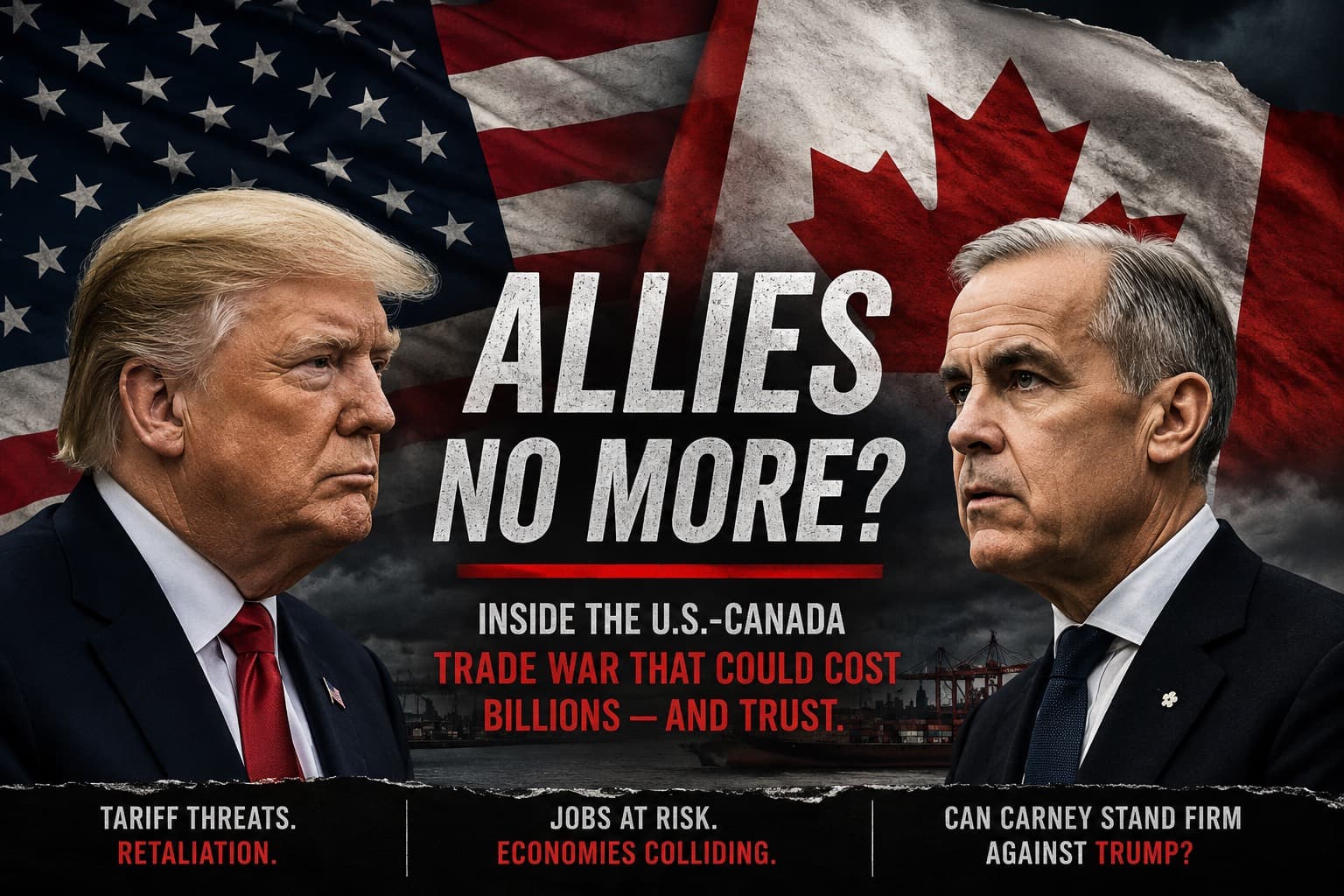

How a decades-old friendship between two allies collapsed into a dollar-for-dollar tariff war — and why neither Washington nor Ottawa is backing down
This is a developing story. IMFounder will continue updating this piece as talks between Washington and Ottawa evolve.
Trump Canada tariffs are no longer a threat — they’re the new reality on both sides of the world’s longest undefended border. On August 22, 2026, the United States imposed 50% tariffs on roughly $20 billion worth of Canadian goods after last-ditch negotiations in Washington collapsed at midnight, ending nearly two weeks of frantic talks between U.S. Trade Representative Jamieson Greer and Canada’s trade minister, Dominic LeBlanc. Within hours, Canadian Prime Minister Mark Carney vowed to hit back “dollar for dollar,” setting the stage for retaliatory tariffs that take effect September 8. If it feels like this fight has been simmering forever, that’s because it has — and the reasons it just boiled over go far deeper than one bad meeting in D.C.
What Just Happened in the Trump Canada Tariffs Standoff
For three days, negotiators worked around the clock inside the Office of the U.S. Trade Representative, trying to lock in a new bilateral framework before Trump’s self-imposed deadline. According to Bloomberg, American negotiators had even agreed mid-week to lower existing tariffs on autos and metals from 25% down to 15%. Then it fell apart anyway.
At 12:01 a.m. on Saturday, the new duties kicked in — enacted under Section 338 of the Tariff Act of 1930, a Depression-era provision that, according to NBC News, had never once been used by any U.S. administration before now. It lets the White House impose duties up to 50% on any trading partner it deems to be “discriminating” against American goods. The tariffs hit everything from hockey sticks and wine to building materials, furniture, plastics, plywood, cement, and clothing — about 5% of Canada’s total exports to the U.S. Energy, potash, fish, and critical minerals were spared.
In his official statement, Prime Minister Carney’s office confirmed that Canada “will match those tariffs dollar for dollar to protect our workers and businesses.” Retaliation lands September 8, targeting American steel, dairy, appliances, agricultural equipment, pulp and paper, and electronics.
Why Talks Collapsed: Both Sides Are Pointing Fingers
Ottawa and Washington can’t even agree on why the Trump Canada tariffs deal died.
Carney told reporters the U.S. side pulled a last-minute switch. As he put it to CNN, Washington’s new terms were “uneconomic” and “unfair” and undermined the deal’s net benefit to Canada — summing it up bluntly: “they asked too much, and they offered too little.” He later called the outcome “a miscalculation.”
USTR Jamieson Greer told a very different story. Posting on X, he framed Canada’s exit as the real betrayal, describing it as a missed opportunity after the U.S. had offered Canada what he called the best treatment of any major exporter to the American market. Trump, for his part, escalated within 48 hours — threatening on Monday to double tariffs on Canadian cars, trucks, and auto parts to 50% starting January 1, 2027, and posting on Truth Social that Canada “will be treated like a State no longer,” per CNBC.
Why Is Trump So Determined to Squeeze Canada on Trade?
This is the question everyone keeps asking, and the honest answer is that it’s less a single grudge than four pressures converging at once.
First, tariffs are the centerpiece of his second-term economic agenda. Trump has framed the U.S. trade deficit with dozens of countries as a national emergency, and Canada — despite being one of America’s closest allies — has been treated no differently than adversaries when it comes to that framing.
Second, two disputes predate Trump entirely. As the Washington Times reported, the U.S. and Canada have wrangled for decades over Canadian softwood lumber — which Washington says receives unfair government subsidies — and over U.S. access to Canada’s tightly protected dairy market. Both were flashpoints again in August’s failed talks.
Third, the legal ground shifted under him. Early in 2026, the U.S. Supreme Court struck down several of Trump’s sweeping emergency tariffs that had been imposed under the International Emergency Economic Powers Act, forcing the administration to find new legal levers — like the never-before-used Section 338 — to keep the pressure on.
Fourth, and most consequential: the USMCA clock ran out. More on that below — it explains the timing better than anything else.
Trump has also made his personal framing explicit. As he put it in a Truth Social post reported by CNBC, Canada does the overwhelming majority of its trade with the U.S. and not the reverse, and in his view that leverage should run one way. Critics, including Canadian officials and independent economists, argue the picture is more balanced than that rhetoric suggests, pointing to nearly $2 billion in goods and 330,000 people crossing the border every single day as evidence of genuine mutual dependence, not one-sided need.
The USMCA Time Bomb: Why 2026 Changed Everything
Here’s the piece of context most casual coverage of the US-Canada trade war 2026 leaves out: this isn’t happening in a vacuum. On July 1, 2026, the USMCA (known in Canada as CUSMA) hit its mandatory six-year joint review — the first review clause of its kind ever built into a major U.S. free trade agreement. Under Article 34.7, all three countries had to confirm in writing whether they wanted to extend the deal another 16 years.
They didn’t. As White & Case detailed, the U.S. formally declined to renew USMCA “in its current form.” The agreement hasn’t collapsed — it remains fully in force, preferential tariffs and all — but it now enters annual joint reviews every year until 2036, when it’s set to expire outright unless the parties agree to extend it sooner. Trade lawyers have started calling this the “zombie USMCA” scenario: technically alive, permanently uncertain, and a source of exactly the kind of leverage that gives Washington an incentive to keep applying pressure sector by sector rather than settle everything at once.
That non-renewal decision landed just seven weeks before the August tariff blowup. It’s the missing link between “why now” and “why so aggressively.”
What’s Actually at Stake: Dairy, Lumber, Autos, and Steel
Strip away the political theater and four industries explain almost the entire fight:
- Softwood lumber: Canada wants relief from tariffs that currently total around 45%, which Washington says offset unfair Canadian subsidies. CBC News reports the U.S. side wants this handled entirely separately from the broader deal — a sticking point in itself.
- Dairy: Canada’s supply-managed dairy system has been a target of U.S. trade complaints for decades, and it remains one of Washington’s core asks in any renewed agreement.
- Autos: Trump’s threatened hike to 50% tariffs on Canadian vehicles by January 2027 would hit an industry where Toyota and Honda alone produced more vehicles in Canada in 2025 than Ford, GM, and Stellantis combined, according to CNBC.
- Steel and aluminum: Already tariffed separately under Section 232, these remain a persistent irritant Canada has repeatedly tried to get folded into a broader settlement.
Canada Strikes Back: A Targeted, Not Blanket, Response
Carney isn’t just talking tough. The September 8 retaliation list — steel, dairy, appliances, agricultural equipment, pulp and paper, electronics — is notably narrower than Canada’s sweeping 2025 countermeasures. It reads like a government aiming precise pressure at politically sensitive U.S. industries and border-state economies rather than escalating indiscriminately.
Who Really Pays? The Economic Fallout on Both Sides
Economists say this isn’t symbolic. ING’s James Knightley told CNBC the tariffs cover only about 5% of Canada’s exports overall, but individual small and mid-sized exporters near the border absorb outsized damage; Capital Economics’ Bradley Saunders warned the most exposed Canadian industries “could be crippled.” The pain isn’t one-directional — Ontario’s forest industry has long argued U.S. lumber tariffs backfire on the roughly 3.8 million American workers in residential construction, an industry that leans heavily on Canadian softwood.
The Story So Far: What IMFounder Has Been Reporting Since Day One
IMFounder has covered this fight from its opening hours in February 2025 through today, and reading that coverage back to back reveals something the day-to-day headlines don’t: this is at least the third time the relationship has collapsed and partially recovered.
February 2025 — the opening shot. Trump’s initial 25% tariff (10% on energy) landed as a genuine shock, and Justin Trudeau’s response — calling it “unjustified, unfair, and frankly illegal” — set the tone for everything since, as we reported in “We Didn’t Ask for This” – The Trade War Between Allies. Within days, Canadians were already organizing consumer resistance, which we covered in Build Canadian and Buy Canadian.
March 2025 — the first “de-escalation” that wasn’t. Boycott pressure and market volatility forced a one-month tariff delay to April 2, which we detailed in Trade War on Hold. Even then, our reporting flagged that the pause looked less like resolution and more like Trump buying time for a domestic manufacturing push — a pattern that would repeat almost exactly seventeen months later.
April 2025 — the backfire becomes visible. Our analysis, Oh America, You Will Hurt Yourself, used Ford Motor Company as a case study to show tariffs raising costs for American consumers rather than reviving domestic manufacturing — the same dynamic economists were still warning about when the 50% tariffs hit in August 2026.
July–August 2025 — the first full collapse. As the August 1, 2025 deadline approached, Trade Tensions and the Economy covered Canada dropping its Digital Services Tax specifically to keep talks alive. It bought only weeks: our follow-up, Why Trump Couldn’t Close a Deal with Canada, concluded his approach favored “pressure over resolution, performance over sustainability” — almost word-for-word what could be written about this week’s collapse.
December 2025 — the boycott hardens into policy. Nearly a year in, Canada’s Boycott of U.S. Alcohol showed provincial governments turning consumer anger into semi-permanent procurement policy, with Alberta and Ontario diverging on how long to hold the line — evidence the dispute had outlasted any single tariff announcement.
January 2026 — rhetoric escalates ahead of the USMCA review. In Canada–U.S. Political Clash: Trump, Carney & Business Impact, we flagged that leadership rhetoric alone — months before any new tariff was announced — was already reshaping investment decisions ahead of the mandatory July 2026 USMCA review.
August 2026 — the cycle repeats at higher stakes. Which brings us to now: 50% tariffs, a September 8 retaliation date, and a USMCA that wasn’t renewed. Same structure as February 2025 and August 2025. Bigger numbers.
Why Does This Keep Happening?
Read eighteen months of this dispute back to back and a clear mechanism emerges — not just bad luck or personal animosity, but a repeating structure with four parts.
There’s no permanent agreement anchoring the relationship. USMCA was supposed to provide that anchor, but its 2026 joint review ended in non-renewal rather than resolution. The deal remains legally in force, but it now faces annual reviews through 2036 instead of a settled 16-year term — which means every year carries a fresh opportunity for the same brinkmanship to resurface.
The same handful of flashpoints never get permanently resolved, only deferred. Dairy market access and softwood lumber were unresolved irritants in February 2025 and remain unresolved in August 2026. Canada’s Digital Services Tax broke the talks in June 2025; a different set of “new demands” broke them in August 2026. Each round trades one flashpoint for another rather than closing the book.
Deadline-driven brinkmanship rewards last-minute escalation. Nearly every round — April 2, August 1, 2025’s negotiations, and August 22, 2026’s collapse — followed the same shape: intense last-week talks, a hard deadline, and a late move by one side that the other calls an unfair surprise. That structure makes collapse more likely than resolution, because neither side has to show its final position until the clock is nearly out.
Both governments have domestic incentives to be seen as tough, not conciliatory. Carney’s approval has tracked closely with how firmly he’s perceived to be standing up to Washington, and Trump has made tariffs the signature tool of his second-term economic agenda. A quick, generous compromise carries political risk for both leaders — a de-escalation that looks like “giving in” is arguably more costly domestically than an ongoing standoff.
Put together, these four dynamics explain why “we didn’t ask for this” in February 2025 and “they asked too much, and they offered too little” in August 2026 are, structurally, the same sentence said eighteen months apart.
What Happens Next
Two dates now anchor the next phase of the Trump Canada tariffs fight. On September 8, Canada’s retaliatory tariffs on American steel, dairy, appliances, farm equipment, pulp, paper, and electronics take effect. On January 1, 2027, Trump’s threatened 50% tariff on Canadian autos, trucks, and parts is set to begin — unless a new deal, or a walk-back, happens first. Layered on top of both is the ongoing annual USMCA review process, which now runs indefinitely until either side agrees to a full extension or the pact reaches its built-in 2036 expiration. Every one of those dates is a fresh opportunity for de-escalation — or for this to get worse before it gets better.
Frequently Asked Questions
What are the new Trump Canada tariffs? As of August 22, 2026, the U.S. imposed 50% tariffs on roughly $20 billion of Canadian goods, covering items like lumber products, furniture, wine, hockey sticks, and clothing — about 5% of Canada’s total exports to the U.S.
Why did the US-Canada trade talks collapse? Both governments blame each other. Canada says the U.S. introduced new, unfair last-minute demands; the U.S. says Canada walked back commitments it had already agreed to earlier that week.
Is USMCA still in effect? Yes. The U.S. declined to renew it for a fresh 16-year term after the July 1, 2026 joint review, but the agreement remains legally in force and now undergoes annual reviews until 2036.
When do Canada’s retaliatory tariffs start? September 8, 2026, targeting American steel, dairy, appliances, agricultural equipment, pulp and paper, and electronics.
Why does US-Canada trade tension keep coming back? No permanent agreement anchors the relationship — USMCA’s 2026 review ended in non-renewal, not resolution. The same flashpoints (dairy, lumber, deadline brinkmanship) recur because each round defers rather than resolves them, and both governments face domestic incentive to look tough rather than conciliatory.