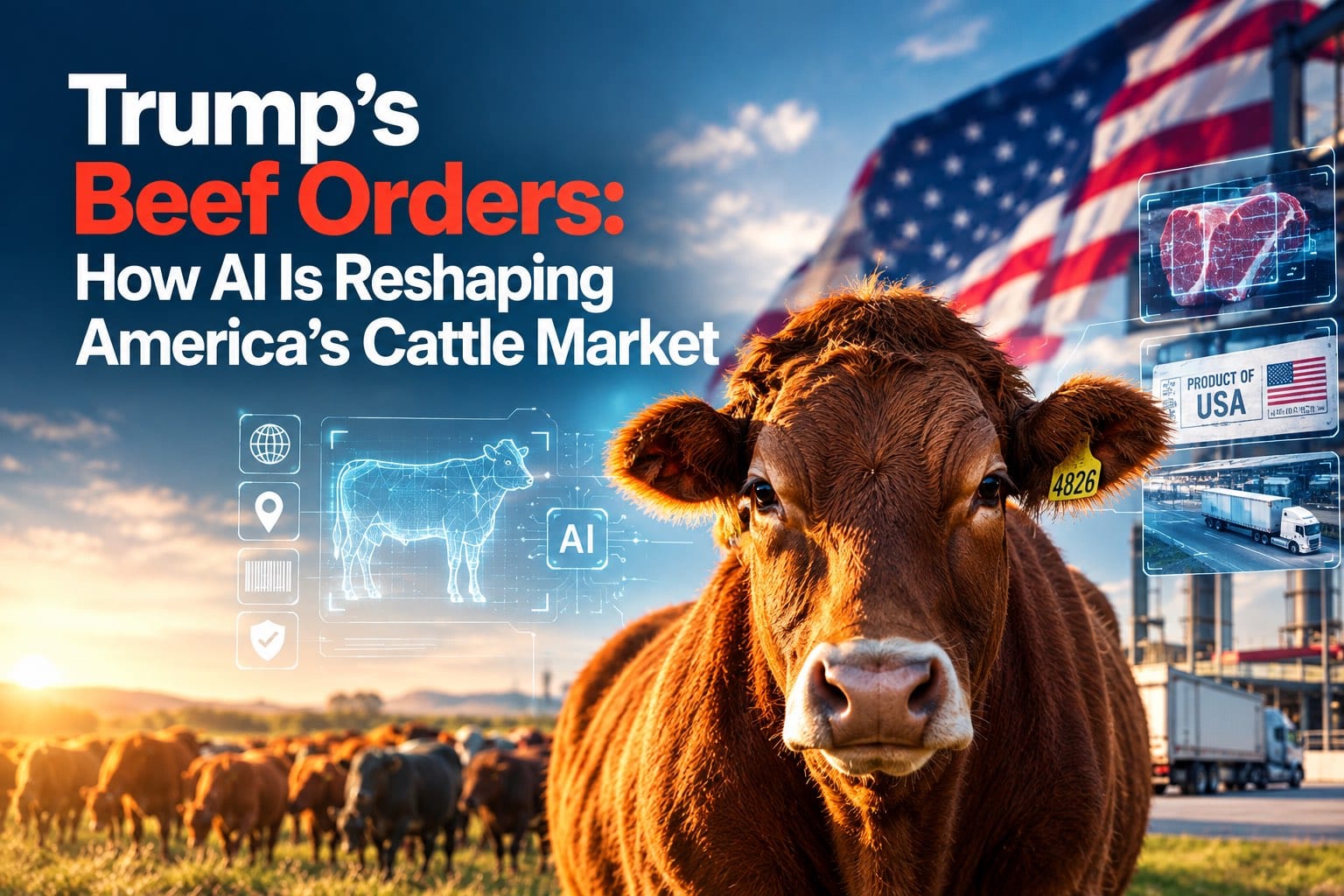

New executive orders connect interstate meat sales, country-of-origin labeling, remote grading and automated inspection. The stated target is cheaper beef. The structural result could be a digitally managed national beef market.
President Donald Trump signed two executive orders on September 4 designed to change how American cattle are protected, processed, graded, labeled and sold.
The public message is straightforward: rebuild the shrinking American cattle herd, increase competition in meatpacking and lower record-high beef prices.
The infrastructure being assembled underneath that message is more consequential.
The administration is directing the U.S. Department of Agriculture to expand interstate sales of state-inspected meat, increase remote beef grading, accelerate instrument-based carcass evaluation and reconsider mandatory country-of-origin labeling. At the same time, Trump is expanding lower-tariff beef imports to increase the immediate supply of ground beef.
This is not one isolated agricultural policy.
It is a national restructuring of the beef market—one combining deregulation, federal oversight, digital inspection, automated grading, foreign supply and domestic-origin marketing.
The farmer may own the cattle. The processor may cut the beef. But the systems controlling inspection, grading, interstate eligibility, traceability and retail distribution will determine who reaches the consumer and who captures the profit.
Watch: Trump Signs the Ranching and Beef Executive Orders
What Trump’s Beef Orders Actually Do
The orders do not immediately authorize every rancher to slaughter cattle on the farm and ship beef anywhere in the country.
They direct federal agencies to expand the regulatory channels through which smaller processors and state-inspected facilities can participate in interstate commerce.
Under the administration’s plan, USDA’s Food Safety and Inspection Service must expand the Cooperative Interstate Shipment and Talmadge-Aiken programs. These programs allow qualifying state-inspected establishments to operate within a federally recognized system and, under defined conditions, sell meat across state lines.
That distinction matters.
Many small slaughterhouses operate under state inspection. Their products may be legal for sale inside their home state but restricted from entering interstate commerce. A rancher can raise an animal, pay a local processor and sell the packaged beef locally, yet remain locked out of customers, restaurants and retailers across the state border.
The September order targets that barrier.
According to the USDA announcement, the administration will also establish a centralized technical-assistance system for small processors and modernize inspection regulations.
That could provide regional producers with additional market access. It could also make interstate participation dependent upon new layers of approved software, documentation, traceability and remote federal verification.
Market access is expanding, but access will still be conditional.
America Has a Beef-Supply Problem
Retail beef prices reached record levels in 2026 as the American cattle inventory fell to its lowest point in roughly 75 years.
The decline did not happen overnight. Drought, wildfires, expensive feed, high interest rates and repeated liquidation cycles reduced the number of cattle available for slaughter. Rebuilding the herd will take years because ranchers must retain breeding animals instead of sending them into the immediate beef supply.
That creates a political and economic conflict.
Consumers want lower prices now. Ranchers need cattle prices high enough to justify rebuilding. Meatpackers need sufficient throughput to keep large plants profitable. Retailers want consistent volume and predictable margins.
Trump is attempting to satisfy all four groups through policies that do not naturally align.
In August, the administration expanded the amount of lean beef trimmings that could enter the country under reduced tariff treatment. A White House proclamation specifically added 80,000 metric tons of Argentine lean beef trimmings to the 2026 tariff-rate quota.
The stated objective was to increase the ground-beef supply and reduce consumer prices. The White House proclamation described the domestic supply as inadequate to meet demand at reasonable prices.
Reuters subsequently reported that the administration expanded access to hundreds of thousands of metric tons of lower-tariff lean beef while simultaneously promoting American ranchers, domestic processing and country-of-origin transparency.
That contradiction defines the policy.
Imported beef offers the possibility of short-term price relief. Domestic herd rebuilding requires long-term investment and favorable producer economics. Increasing imported supply may place downward pressure on the cattle prices American ranchers receive before they have rebuilt their herds.
Trump is trying to lower the price of beef without lowering the financial incentive to produce beef.
“Product of USA” Does Not Mean Mandatory American Labeling
Country-of-origin labeling occupies the political center of the new plan.
Trump directed USDA, working with the Office of the United States Trade Representative, to review its authority to pursue mandatory country-of-origin labeling through regulation or legislation.
Mandatory labeling is not currently in effect.
Congress repealed the previous mandatory country-of-origin requirements for beef and pork in 2015 after World Trade Organization disputes involving Canada and Mexico. Reinstating a mandatory system will require additional governmental action and could produce new trade challenges.
The current Product of USA designation remains voluntary.
However, the meaning of that designation changed in 2026. Beef bearing the claim must now come from animals born, raised, slaughtered and processed in the United States. Before the rule changed, imported cattle or meat could potentially receive a U.S.-origin claim after undergoing processing inside the country.
The revised standard closes that opening.
Producers using the voluntary label must maintain supply-chain documentation, traceability records, segregation controls and signed statements supporting the claim. Imported beef can still be legally sold in the United States, but it cannot carry the Product of USA designation unless it satisfies the domestic-origin requirements.
This creates two parallel products: beef sold as a commodity and beef sold through a verified national identity.
That identity can command a premium.
Labels are not merely consumer information. They are market infrastructure. Whoever controls verification controls access to the premium created by the label.
AI Is Entering Beef Grading
The least discussed provision may become the most structurally important.
USDA announced that it will nearly double participation in its remote beef-grading program. The system combines smartphones, digital images, data management and off-site federal oversight, allowing authorized graders to evaluate carcasses without remaining physically stationed inside every participating plant.
The administration is also expanding instrument-enhanced grading.
Instrument grading uses imaging equipment and computerized measurements to evaluate carcass characteristics. USDA reports that the system is already used on approximately 20 percent of fed cattle—roughly 20,000 head per day.
According to the department, participating facilities can sometimes reduce grader staffing by as much as half.
That is labor displacement through food infrastructure.
The agency describes the technology as a method of improving efficiency, consistency and accuracy. For processors, it can lower staffing requirements and make grading accessible to facilities that cannot support a permanent on-site grader.
For workers, it transfers judgment from a person standing beside the carcass to a technology-mediated system collecting images, measurements and standardized data.
The grader does not necessarily disappear immediately. The grader becomes remote, centralized and responsible for more facilities. The plant reduces its on-site labor requirement. The database grows.
This follows the same pattern already appearing across food retail, restaurants and distribution.
More than two-thirds of food retailers surveyed by FMI in early 2026 reported using artificial intelligence, compared with 47 percent one year earlier. Fifty-nine percent reported using generative AI, while companywide implementation more than doubled.
Restaurants are deploying AI for scheduling, inventory, purchasing, pricing, marketing, drive-through ordering and labor management. Distribution companies are investing in autonomous transportation and digitally controlled logistics. Retailers are using predictive systems to determine ordering, markdowns and product placement.
As documented in IMFounder’s investigation, Ghost Trucks: Inside America’s Driverless Food Distribution Network, automation is moving through the physical food supply chain—not simply through office work.
Beef grading is the next layer.
The Battle Is Over Processing Capacity
Four companies have historically controlled a dominant share of American beef processing: Tyson Foods, JBS, Cargill and National Beef, which is controlled by Brazil-based Marfrig.
That concentration gives large packers enormous influence over slaughter capacity, cattle purchasing and the flow of boxed beef into national distribution.
Trump’s competition order directs USDA to prioritize investigations under the Packers and Stockyards Act, increase enforcement resources and coordinate with the Department of Justice.
The administration also wants more regional processors, producer cooperatives and small facilities entering the market. Its SPUR initiative offers financing support intended to preserve or expand smaller processing operations.
This sounds like decentralization.
But constructing a slaughterhouse is not enough. A facility needs inspectors, wastewater capacity, refrigeration, labor, transportation, insurance, digital traceability, grading access and buyers. It must operate at sufficient volume to cover substantial fixed costs.
Remote inspection and technology-assisted grading could reduce some barriers. They could also standardize smaller plants inside a national digital system.
The processor becomes independent from the dominant packer but dependent upon approved technology, federal data systems and platform-compatible distribution.
The infrastructure changes. Dependency remains.
This follows the same pattern examined in 7 Powerful Moves Quietly Reshaping the Food Industry: production may remain fragmented while distribution, information and market access consolidate.
Who Benefits From Interstate Beef Sales?
Regional ranchers could benefit if the expansion gives them access to restaurants, subscription customers and retailers outside their state.
Independent chefs and hospitality operators could gain access to differentiated regional beef without relying exclusively on broadline distributors. Rural communities could retain more processing revenue instead of shipping livestock hundreds of miles to large facilities.
Consumers could receive clearer origin information and more purchasing options.
None of those outcomes is automatic.
Smaller processors will face compliance costs. Remote grading systems require equipment, connectivity, training and documentation. Traceability creates transparency, but it also creates data. That data can reveal volume, yield, carcass quality, supplier relationships and commercial performance.
The central question is who owns it.
If public infrastructure remains open and accessible, smaller processors could compete more effectively. If required technology becomes proprietary, expensive or controlled by a narrow group of vendors, market access will shift from the major meatpacker gate to the software gate.
A rancher could be legally authorized to sell interstate and still lack practical access to national customers.
Permission to enter a market is not the same as power inside that market.
Beef Is Becoming a Digitally Governed Commodity
Trump’s executive orders are being marketed as rancher protection and consumer relief. Their long-term significance lies in how they connect physical beef production with national digital oversight.
The emerging system contains several layers:
- Verified animal and product origin
- Digital traceability and segregation records
- Remote federal inspection and grading
- Instrument-generated carcass measurements
- Interstate certification
- Algorithmic retail forecasting
- Concentrated logistics and distribution
Together, these systems determine which animal becomes premium beef, which processor can cross state lines, which label appears on the package and which product receives shelf space.
AI does not have to raise the animal or operate the knife to control the economics.
It only needs to control the classification, verification and movement of the product.
Trump may succeed in opening interstate markets to more processors. The administration may also improve the meaning of American-origin claims and reduce selected regulatory barriers.
But the immediate price problem remains.
America cannot digitally grade cattle that do not exist. Remote inspection cannot reverse years of herd contraction. Imported trimmings may reduce pressure on ground-beef supplies, but they do not rebuild domestic breeding stock.
The policy is attempting to solve a biological shortage with trade adjustments, deregulation and technology.
The deeper transformation will remain after the current price crisis passes.
American beef is moving toward a market in which every commercially valuable claim—origin, quality, grade, eligibility and destination—is documented and digitally verified.
The question is no longer simply who raises the cattle.
The question is who controls the system that decides what the cattle are worth.
Related Articles on IMFounder
- Meet CA-1, This Robot Can Cook 800 Meals a Day Without a Traditional Kitchen
- How Sysco Corporation Consolidated the Middle Layer of Food Distribution
- Why Starbucks’ TikTok Creator Program Changes the Future of Work
- GLP-1 Is Eating the Food Industry From the Inside Out
- The Restaurant Industry: The Fastest Way Into the Economy Is Closing
- AI Is Turning Food Into a Programmable Material