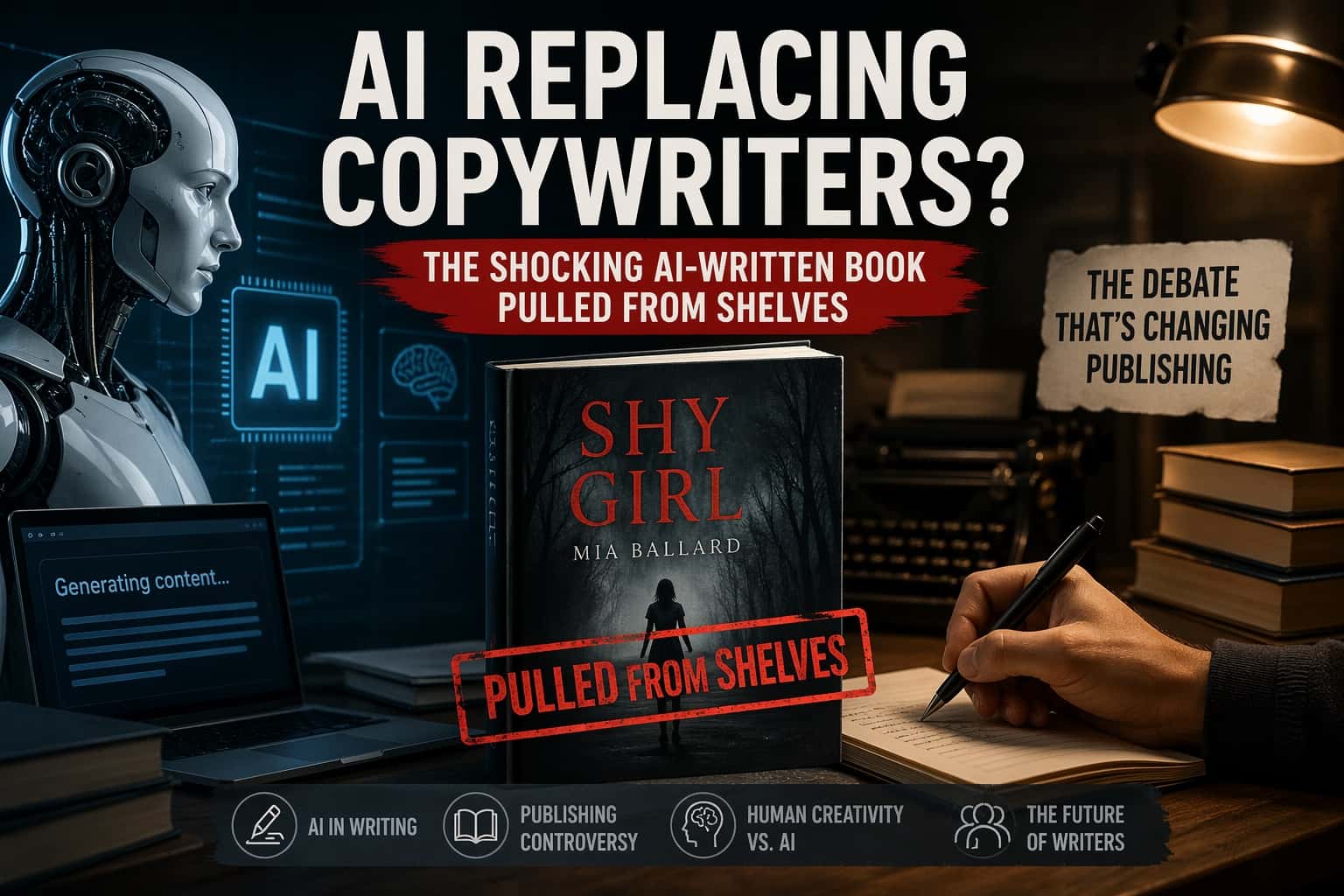

And the AI-written book that was pulled from shelves
Artificial intelligence is no longer knocking on the door of the writing world. It’s already inside. From marketing copy to novels, AI tools are being used to draft ideas, outline books, generate headlines, and even produce full manuscripts. The question isn’t whether AI is influencing writing. The real question is whether it’s replacing writers, or simply reshaping the industry.
Right now, the answer is complicated.
The Rise of AI in Copywriting and Publishing
AI has changed the speed of content creation dramatically. Tasks that once took hours, like brainstorming headlines or drafting blog outlines, can now happen in minutes. Many agencies already use AI to generate first drafts, optimize SEO, or test variations at scale.
For copywriters, this shift is both opportunity and pressure. Businesses want content faster and cheaper, but they also want stronger messaging. AI can produce volume, but it still struggles with emotional nuance, brand voice, and original storytelling. That’s where human writers remain essential.
Industry discussions increasingly frame AI as a tool rather than a replacement. Some writers are using it to accelerate research, generate ideas, or refine structure while still controlling the final voice and narrative. Others worry that clients may start relying entirely on AI-generated content, lowering budgets and expectations.
The tension between speed and originality is now shaping the future of writing.
The Book That Sparked the Debate
The conversation intensified recently when a horror novel titled Shy Girl by Mia Ballard was pulled from publication after accusations that it had been written using artificial intelligence. A major publisher canceled the book’s release and removed it from shelves following reader suspicion and an internal investigation.
The controversy began when readers noticed patterns typical of AI-generated text, including repetitive phrasing and inconsistent narrative logic. Online discussions quickly spread across Reddit and social media, prompting the publisher to investigate.
Eventually, the publisher halted sales and canceled the U.S. release while discontinuing the book in other markets. The move marked one of the first high-profile cases where a major publishing house withdrew a book over suspected AI involvement.
Reports also noted that AI detection tools suggested a large portion of the text might be AI-generated, fueling concerns about authenticity and editorial oversight.
The author denied writing the book with AI and said an editor may have used AI tools during revisions, highlighting another emerging issue: even partial AI use can create controversy about authorship and originality.
Why This Matters for Writers
The removal of Shy Girl wasn’t just about one book. It exposed a larger concern in publishing: trust.

Readers want to know a story came from a human perspective. Publishers want originality they can stand behind. And authors want recognition for their creative work.
When AI enters the process, those lines blur.
This has already led to other industry reactions. Thousands of authors recently published an “empty” protest book to push back against AI companies using their work without permission, showing how strongly many writers feel about protecting human creativity.
Is AI Replacing Copywriters?
Not exactly. But it is changing what copywriters do.
Writers who only produce basic, formulaic content are more vulnerable because AI can replicate that quickly. But strategy, storytelling, positioning, and emotional resonance still require human insight.
In fact, AI is pushing copywriters to evolve into:
- Brand storytellers
- Messaging strategists
- Voice specialists
- Content directors
- Editors of AI-assisted drafts
The value is shifting from typing words to shaping meaning.
The Future of Authors in an AI World
For authors, AI opens new possibilities. It can help with plotting, world-building, and drafting scenes. Some writers use it as a brainstorming partner. Others avoid it entirely to preserve pure authorship.
But the Shy Girl controversy shows something important. Readers still care deeply about authenticity. A book isn’t just content. It’s voice, experience, and perspective.
AI can mimic structure. It cannot replicate lived experience.
That distinction may define the next era of publishing.
The Bottom Line
AI isn’t taking over writing. It’s redefining it.
Copywriters who lean into strategy will become more valuable. Authors who focus on originality and voice will stand out even more. And publishers will likely introduce clearer rules around AI disclosure.
The writers who thrive won’t be the ones competing with AI.
They’ll be the ones using it intentionally while keeping the human voice at the center.
Because in the end, readers don’t just want words.
They want meaning.
Related Articles on IMFounder
- 7 Explosive AI Updates in April 2026 — That Will Shock Every Founder
- The Rise of AI in Creative Industries — Boon or Bane?
- Agentic AI Is Already Changing How Founders Operate in North America — Are You Ready?
- Your Favorite AI Startup Isn’t an AI Company — They Just Wrap Existing ModelsThe AI Sound
- From viral AI-generated songs to industry backlash — How Artificial Intelligence Is Redefining Music
- A.I. Social Media Accounts Are Growing Faster Than Humans — And It’s Changing Everything
- The Truth About AI Girlfriends & Digital Companionship — Discover how AI girlfriends and digital companions are reshaping intimacy
Sources
- The Guardian — Thousands of authors publish “empty” book in protest against AI training
- Futurism — Horror novel pulled after accusations it was written using AI
- The Week — Why “Shy Girl” was removed amid AI writing controversy
- People — Publisher cancels horror novel “Shy Girl” following AI allegations
- LinkedIn News — Publisher pulls horror novel over AI claims
- Publishers Weekly — Industry response to AI generated manuscripts in traditional publishing
- The Authors Guild — AI, authorship, and publishing rights discussions
- PEN America — Generative AI and the future of creative writing