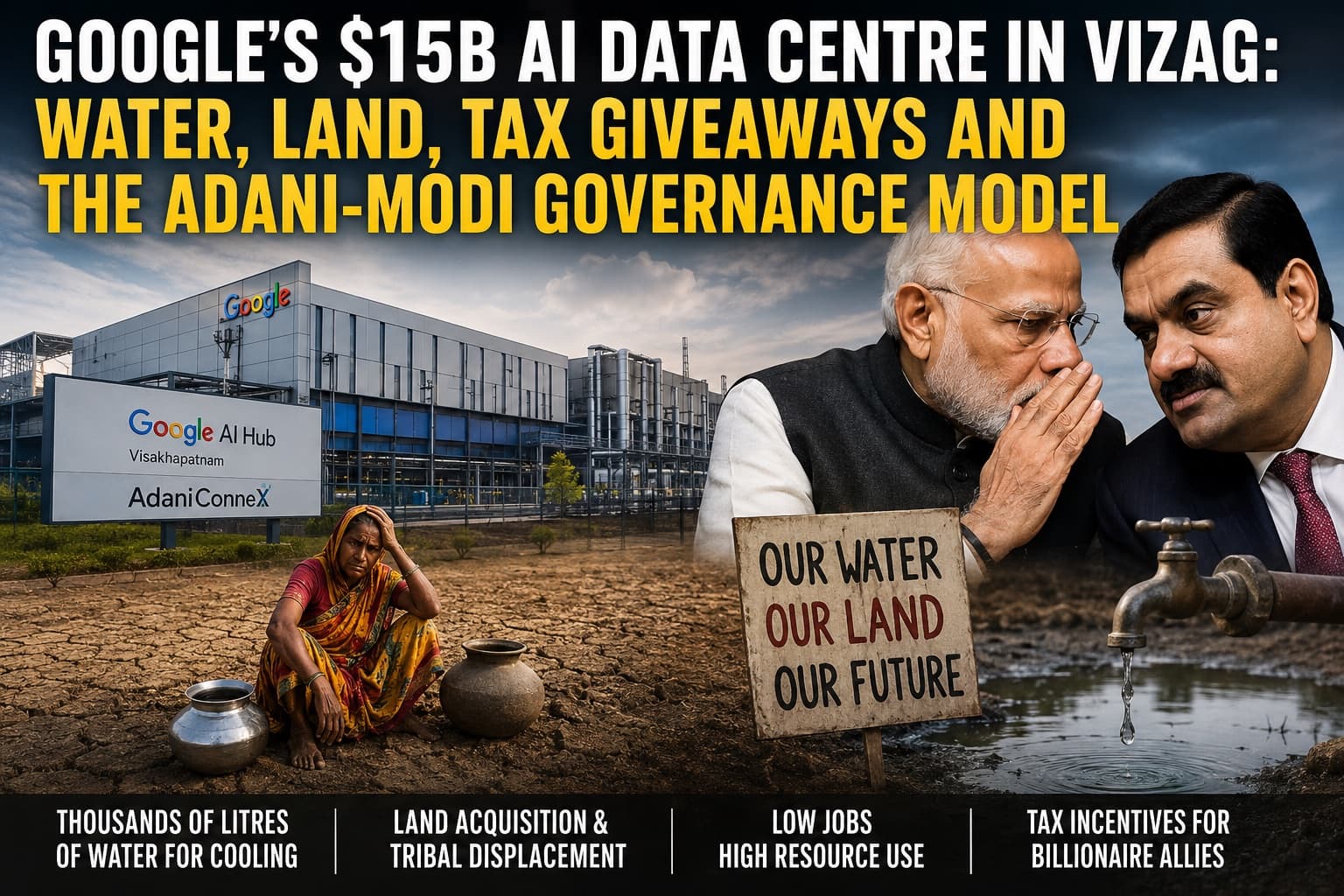

Visakhapatnam (Vizag) is being positioned as the next big node in India’s AI and cloud infrastructure. Google says it has broken ground on an AI hub in Vizag as part of a $15 billion investment, built with ecosystem partners including AdaniConneX and Airtel (Nxtra). (blog.google)
Supporters frame this as digital progress.
But a serious public-interest debate is growing: Is India trading water security, land rights, and environmental safeguards for headline-grabbing investments — while politically connected infrastructure allies take centre stage?
This article follows the exact accountability questions people are asking.
1) What Google is building in Vizag — and why it’s not “just another IT campus”
Google’s own statements describe Vizag as a construction-phase milestone for its AI hub, tied to a $15B investment. The project is described as gigawatt-scale and structured around multiple data centre campuses, with AdaniConneX and Airtel/Nxtra involved in construction and connecting infrastructure. (blog.google)
Why that matters:
- Gigawatt-scale data centres are industrial infrastructure.
- They reshape electricity demand, cooling needs, and land use for decades.
- They are not comparable to typical software office parks.
2) “After America, AI is coming for India’s water” — the environmental fear behind the hype
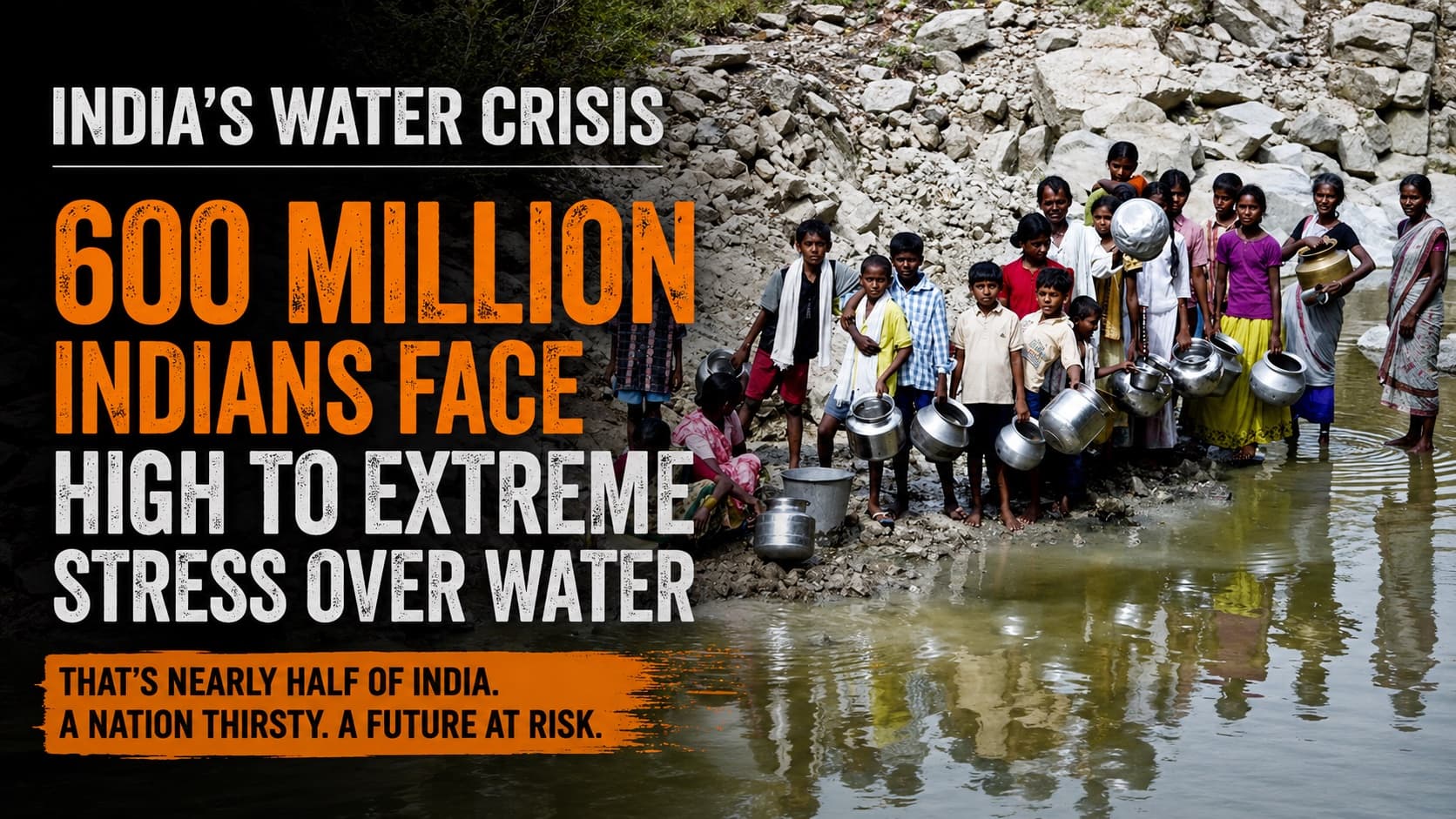
India’s baseline reality: water stress is already an emergency
India is not a country with abundant surplus water to burn. Many regions face seasonal shortages and long-term groundwater decline. That’s why large new water-intensive facilities should face higher scrutiny, not faster approvals.
Data centres can be water-intensive — and civil society groups are warning about Vizag
The Human Rights Forum (HRF) publicly warned that the Google–Adani data centre complex could become a “looming environmental and economic disaster,” specifically highlighting concerns about these facilities being water- and energy-hungry and questioning the way the project is being pushed. (Human Rights Forum)
This is the central governance question:
If the state knows water is scarce, why is it comfortable approving new “always-on” infrastructure that could intensify local water competition?
Your ethanol comparison is not just emotion — it’s backed by policy documents
India is already incentivising water-heavy industrial outcomes. The ethanol example proves the pattern.
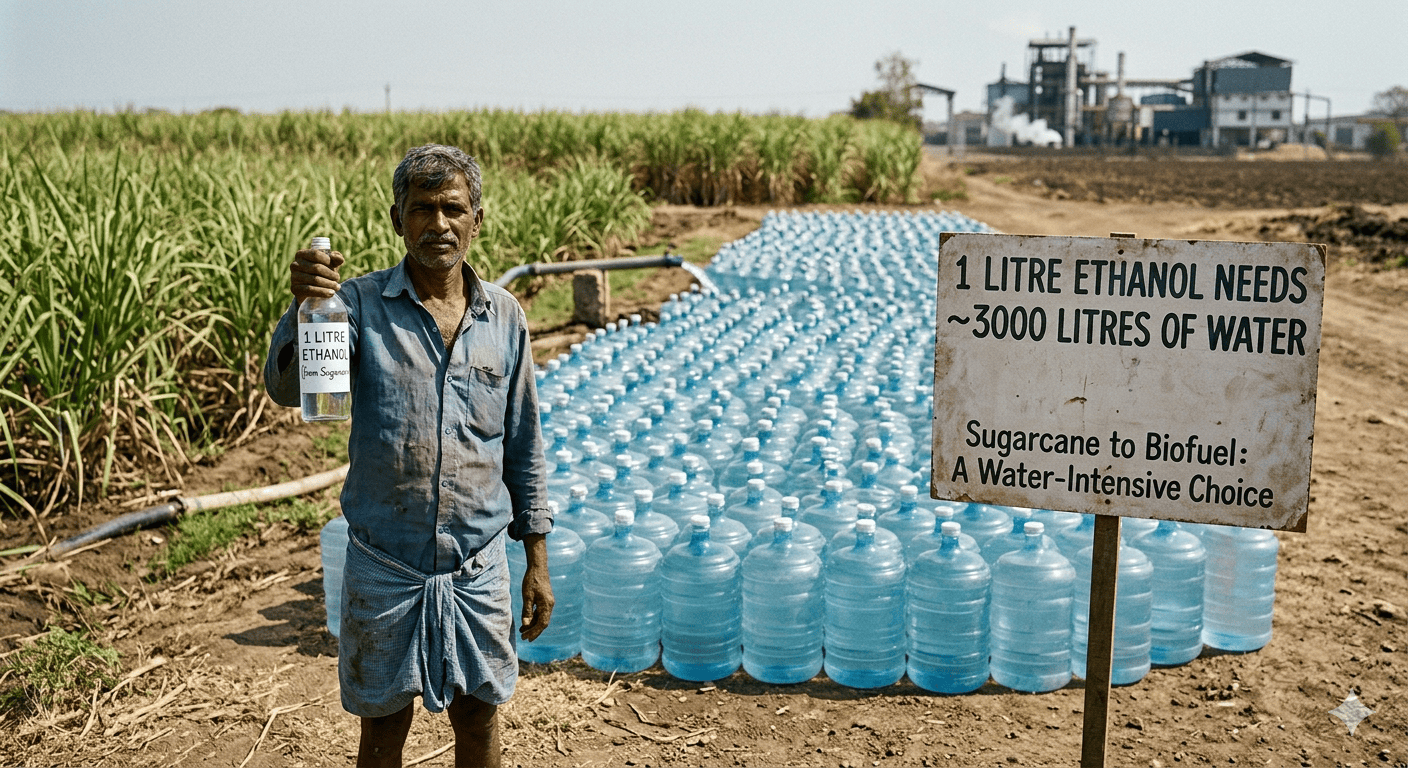
- NITI Aayog’s ethanol roadmap notes sugarcane’s high water intensity and states that one litre of ethanol from sugar can require ~3000 litres of water (their wording and calculation context). (NITI AAYOG)
- A PRS summary of the same NITI Aayog report cites ~2,860 litres of water per litre of ethanol from sugar and flags water conservation concerns. (PRS Legislative Research)
So the criticism is straightforward:
When citizens struggle for drinking water, why do policy and approvals keep enabling water-intensive industrial systems — and now hyperscale AI infrastructure too?
3) Why is Adani at the forefront again — and what this says about the “Modi-era governance model”?
This isn’t speculation: AdaniConneX is explicitly named as a partner in Google’s Vizag AI hub announcements. (blog.google)
And there’s more: an Indian investment-promotion body reports that the Andhra Pradesh government allotted 480 acres across Visakhapatnam/Anakapalli linked to the project and describes Adani Infra/Adani entities as “notified partners” for Google’s India subsidiary in the build-out. (India Brand Equity Foundation)
Critics ask:
- Why do a small set of politically powerful conglomerates repeatedly land “strategic infrastructure” roles?
- What were the selection criteria?
- Were alternatives evaluated transparently?
- Are incentives and fast-track approvals being used to shape winners?
Important line between facts and accusations:
- It is factual that Adani entities are central partners here.
- It is also factual that civil society groups like HRF frame this as dangerous and politically enabled. (Human Rights Forum)
- What must be demanded (and published) are the MoUs, tender logic, land terms, and incentive conditions—because without those, India can’t even verify whether it was fair.
4) What do Vizag residents actually get — cheap power, clean air, clean water… or health risk + “job promises”?
This is where “FDI headlines” collide with lived reality.
The job truth many governments don’t advertise
Data centres create many temporary construction jobs, but far fewer permanent operational jobs than people expect.
- A 2025 workforce analysis estimates construction intensity ~0.7–2.0 workers per MW, while ongoing operations are ~0.15–0.35 FTE per MW once online; highly automated hyperscale campuses can operate with as few as 20–30 permanent staff per 100 MW. (hamminstitute.org)
- Brookings has also highlighted that public debates often overstate job impacts and that better jobs data is needed in policy decisions. (Brookings)
So the question becomes:
If the permanent job count is modest, what is the concrete return for locals in exchange for land, water risk, and grid burden?
What residents should demand in writing (not speeches):
- Public water-use disclosure (monthly), withdrawal limits, and independent audits
- A binding local healthcare and heat-mitigation fund
- Guaranteed local skill pipelines + minimum local hiring targets
- Transparent electricity cost accounting (so households don’t subsidise corporate tariffs indirectly)
Without measurable commitments, locals may get:
- Resource pressure + environmental exposure
- Limited long-term jobs
- And a city branded as “AI hub” while quality-of-life declines
5) Land acquisition, tribals, and environmental warnings — is the state ignoring red flags?
Land is not an abstract “asset” for people; it is livelihood, identity, and community stability.
- Times of India has reported land acquisition actions tied to Google’s data centre project area in Visakhapatnam (Raiden Infotech, Google’s subsidiary) and allocation via APIIC. (The Times of India)
- HRF alleges the project is being enabled in ways that could produce long-term ecological and economic harm, calling out the state’s approach and warning about environmental consequences. (Human Rights Forum)
This is where the governance failure charge lands hardest:
If environmental warnings exist, why are they not being treated as stop-signs until addressed with transparent data?
At minimum, a credible democracy does:
- Public hearings that can change project conditions
- Published environmental and water-impact documents
- Independent monitoring (not just developer self-reporting)
6) Low job creation vs high resource use — the imbalance at the heart of the controversy
Put simply:
- AI data centres can demand enormous power and potentially significant water (depending on cooling design and climate).
- The long-term job footprint can be thin relative to the land + energy footprint. (hamminstitute.org)
This is exactly why communities globally are pushing for rules on:
- water, energy procurement, siting, and cost recovery
(World Resources Institute describes how outcomes depend on strong rules, not hype.) (World Resources Institute)
India is late to that regulatory seriousness — and that’s what makes the Vizag case so explosive.
7) Why the tax incentives and freebies — and why citizens should demand the numbers
States often compete for data centres with policy incentives. But in this project, the incentive scale being discussed is enormous.
An Indian investment-promotion report states Google’s India subsidiary’s phased plan in Andhra Pradesh totals ₹87,500 crore investment and mentions ~₹22,000 crore in estimated incentives over time. (India Brand Equity Foundation)
That leads to the bluntest question in your list:
Why are governments offering large incentives to mega players while citizens deal with high bills, water stress, and weak healthcare?
If incentives are granted, they should be conditional on:
- Water neutrality or strict caps + verified reporting
- Renewable “additionality” (new clean power added, not just paper claims)
- Local public benefits that are measurable and enforceable
- Penalties for non-compliance
Otherwise, it looks like what critics call the Modi-era pattern:
public resources socialised, private gains concentrated.
Final Take: India needs AI infrastructure — but not the “Modi–Adani governance template”
The Vizag AI hub is not just a tech story. It’s a democracy and public-health story.
If this project is truly for national progress, publish and guarantee:
- water numbers
- land terms
- incentive details
- environmental safeguards
- measurable local benefits
- independent audits
Because without that transparency, “AI future” becomes another chapter in a familiar India story:
beautiful places turned into resource frontiers, citizens left with the risk, and politically connected partners left with the upside.
Quick FAQ
Is Google investing $15B in a Vizag AI hub?
Google and its partners describe a $15B investment and a gigawatt-scale AI hub in Visakhapatnam, with AdaniConneX and Airtel/Nxtra involved. (blog.google)
Is land being allocated/acquired for the project?
Reports describe land acquisition/allocation actions and government allotments connected to the data centre development in the Vizag region. (The Times of India)
Why are people worried about water?
Civil society groups warn data centres can be water- and energy-intensive; India’s water stress makes this a governance flashpoint. (Human Rights Forum)
How water-intensive is ethanol (for comparison)?
NITI Aayog-linked reporting and summaries cite ~2,860–3,000 litres of water per litre of ethanol from sugar-based pathways. (NITI AAYOG)
Related Articles on IMFounder
- AI Is Quietly Draining the Planet: The Hidden Carbon and Water Crisis Behind Artificial Intelligence
- 7 Explosive AI Updates in May 2026 That Will Shock Every Founder
- Elon Musk’s xAI Commits Over $20 Billion to Mississippi: Inside the Largest Tech Investment in State History