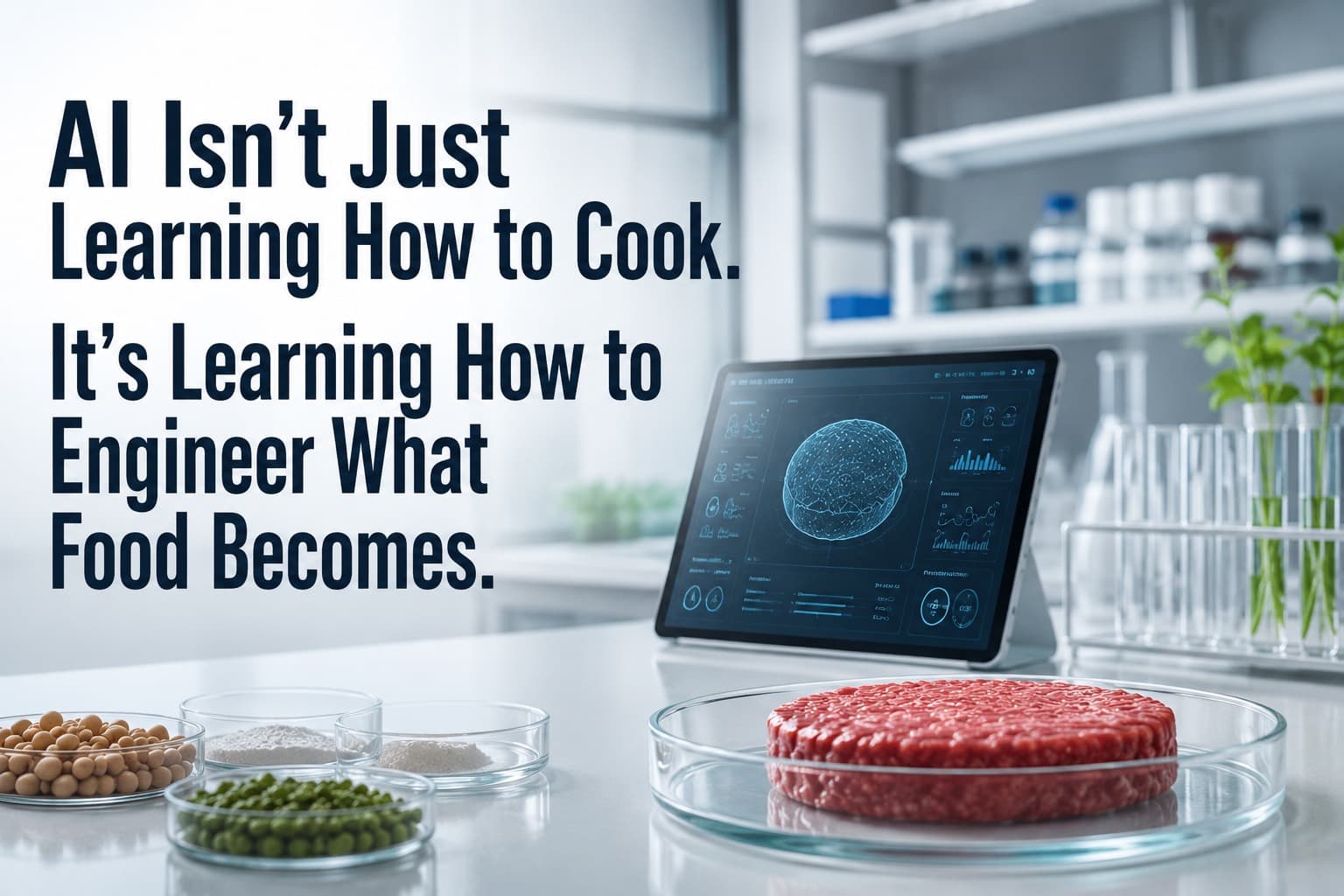

AI Isn’t Just Learning How to Cook. It’s Learning How to Engineer What Food Becomes.
For most of human history, food innovation followed a remarkably stable process. Someone grew, raised or harvested an ingredient; someone transformed it through heat, fermentation, preservation or mechanical force; and eventually a human tasted the result. Even industrial food science followed roughly the same logic. Researchers could manipulate proteins, starches, fats, emulsifiers and flavor compounds with extraordinary precision, but development remained a physical process built around formulation, experimentation, sensory evaluation and reformulation.
Artificial intelligence is beginning to break that sequence. In July 2026, researchers writing in Nature Food described an emerging model in which AI connects molecular composition with physical performance, predicts sensory outcomes, assists ingredient design, directs fermentation and eventually works alongside automated laboratories capable of running parts of the food-development process themselves. The researchers used a phrase that deserves considerably more attention outside food science: food as a “programmable biomaterial.”
That changes the conversation completely. Food is no longer being considered exclusively as agriculture, cooking or even manufacturing. Researchers are beginning to treat it as biological material whose molecular composition, structure, texture, nutritional profile, environmental footprint and sensory characteristics can increasingly be computationally designed.
“The next generation of food may not begin with a farmer, a recipe or a chef. It may begin with a specification.”
Food Is Becoming a Computational Problem
Food is an extraordinarily complicated material system. A single product can contain proteins, carbohydrates, fats, water, minerals, volatile aroma compounds and thousands of molecules interacting across different temperatures, pressures and processing conditions. Those interactions determine whether something stretches, melts, browns, emulsifies, fractures, smells roasted, tastes bitter or feels creamy against the tongue. Change one component and several others may change with it.
Historically, humans managed that complexity through accumulated knowledge and physical experimentation. Chefs call it technique. Food scientists call it formulation and validation. Manufacturers call it research and development. AI introduces another method because machine-learning systems can search relationships among ingredients, processing conditions, nutritional requirements, physical characteristics and sensory outcomes simultaneously. Instead of physically testing thousands of possible formulations, computational systems can eliminate enormous numbers of poor candidates before researchers decide which products are worth making.
That does not eliminate the laboratory or the chef. It changes what reaches them. The difference resembles designing an aircraft entirely through physical prototypes versus using computational simulation to eliminate thousands of unsuccessful designs before manufacturing the first one. Food is acquiring that computational layer, and once taste, texture, cost, nutrition and sustainability become variables inside the same optimization problem, the recipe starts looking less like instructions and more like code.
“Once taste, texture and nutrition become variables inside the same optimization problem, a recipe stops looking like instructions and starts looking like code.”
AI Has Already Started Learning the Human Palate
One of the clearest demonstrations arrived in 2026 when researchers used generative AI to learn patterns embedded across large collections of human-created recipes. This was not another chatbot being asked to invent dinner. The researchers developed a diffusion-based model that learned distributions of ingredients and quantities, effectively creating a mathematical representation of how humans have historically assembled burgers.
The model then navigated that culinary design space according to different objectives, including taste, nutrition and environmental impact. Researchers physically prepared the resulting burgers and subjected them to blinded human sensory evaluation. The significance was not that a machine had produced something edible; recipe generators crossed that threshold years ago. The significance was that AI could learn statistical structure from human culinary behavior and use it to explore an ingredient space containing a number of potential combinations far beyond what a conventional R&D team could physically test.
The implications reach far beyond hamburgers. Once human sensory preferences can be represented computationally, food development begins moving from repeated physical experimentation toward predictive design. AI does not need biological taste buds if sufficiently large datasets allow it to recognize the mathematical patterns produced by humans who do.
“AI does not need taste buds if it can learn the mathematical footprint left behind by millions of humans who do.”
Now Give the Algorithm a Laboratory
The next stage is considerably more consequential. The Nature Food researchers identify self-driving laboratories as a major priority for AI-driven food innovation. Similar systems already exist in chemistry and materials science, where automation, robotics, machine learning and laboratory instruments can operate in a closed experimental loop. Software proposes an experiment, automated equipment performs it, sensors measure the result, AI analyzes the data and that information determines what should be tested next.
Applied to food, that architecture could radically compress product development. Imagine asking a system to develop a high-protein food with the fibrous resistance of chicken, substantially less saturated fat, a specified nutritional profile, commercial refrigeration stability, a manufacturing cost below a fixed threshold and a minimum sensory score. Instead of a food-science team manually working through hundreds of formulations, AI could narrow the ingredient space, predict interactions and direct automated equipment toward the most promising candidates. Instruments could then measure texture, moisture retention, structure and color before those results flow back into the model for another iteration.
The important distinction is that AI would no longer merely suggest a recipe. It would participate in an experimental cycle of prediction, manufacture, measurement and reformulation. Food R&D begins shifting from make-test-adjust toward predict-make-measure-learn, with humans increasingly supervising a computational discovery process rather than manually generating every candidate.
“The real disruption begins when AI stops suggesting the experiment and starts deciding which experiment happens next.”
Microbes Are Becoming Manufacturing Platforms
Programmable food becomes considerably more powerful when AI is combined with biotechnology. Fermentation has produced food for thousands of years, but precision fermentation turns microorganisms into manufacturing platforms capable of producing specific proteins, fats, enzymes, vitamins and other functional ingredients. Instead of merely cultivating a crop and extracting what biology happens to provide, researchers can increasingly engineer biological systems around a desired output.
AI can accelerate that process by analyzing microbial behavior, metabolic pathways, fermentation conditions and enormous biological datasets that would be difficult for humans to evaluate simultaneously. The result is a food-development system in which the ingredient itself can become an engineered output rather than a fixed starting material. Agriculture traditionally asks what nature can grow; programmable food increasingly asks what biology can be instructed to manufacture.
That distinction matters because it moves computational design upstream. The algorithm is no longer simply deciding how much of an ingredient belongs in a recipe. Eventually, it may help determine what properties the ingredient itself should possess before a microorganism manufactures it.
“The factory is becoming biological, and the instructions controlling what it produces are becoming computational.”
Food Can Now Be Programmed in Three Dimensions
The physical architecture of food is becoming programmable as well. Modern 3D food printing is moving beyond novelty chocolates and decorative shapes toward precise control over where edible materials are deposited and how their structure changes the eating experience. Research systems can manipulate geometry, ingredient placement and internal structure, while newer work is investigating how digital fabrication can control sensory characteristics including taste distribution and texture.
Researchers at Saitama University, for example, developed TastePrint, a system designed to control the location and intensity of seasoning within layers of 3D-printed food. That may sound like an engineering curiosity until the implications are considered. Conventional cooking distributes seasoning through physical processes such as coating, mixing, marinating and diffusion. Digital food fabrication creates the possibility of specifying exactly where a sensory stimulus occurs inside the structure.
The future food product could therefore be designed around a sequence of experiences rather than a conventional ingredient list. Resistance during the first bite, structural fracture, salt perception, fat release, aroma release, juiciness and lingering umami can increasingly be treated as engineering objectives. Instead of asking how to make one ingredient imitate another, researchers can ask what molecular composition and physical architecture will generate the sensory sequence the human brain expects.
“The future factory may not simply manufacture the food. It could manufacture the sequence of sensations your brain experiences while eating it.”
This Could Transform Human Nutrition
There is an extraordinary medical and nutritional upside to programmable food. Computational formulation could allow scientists to optimize multiple objectives simultaneously rather than accepting the tradeoffs embedded in conventional products. Foods could potentially be engineered around nutritional density, allergen restrictions, reduced environmental impact, specific metabolic requirements or controlled texture for people with swallowing disorders.
For hospitals, rehabilitation centers and elder care, this becomes particularly significant. Dysphagia can make ordinary foods dangerous or impossible to consume, forcing patients toward texture-modified meals that are frequently visually unappealing and nutritionally difficult to customize. Digitally structured food creates the possibility of controlling texture while restoring recognizable shape, improving nutrition and tailoring the product to the individual patient.
Personalized nutrition could eventually push the concept further. If metabolic measurements, microbiome information, continuous glucose data or other biomarkers become integrated into computational food design, the traditional assumption that everyone at a table should receive biologically identical food begins to weaken. Two people could theoretically eat dishes designed to appear and taste similar while containing different nutritional architectures.
That could be transformative medicine. It could also create an entirely new category of surveillance, commercialization and inequality around food. The technology itself does not decide which future arrives. The optimization target does.
“Programmable food could optimize dinner for human health. It could just as easily optimize it for margin, shelf life and repeat consumption.”
The Dangerous Question Is What We Tell AI to Optimize
Every optimization system requires an objective, and this may become the central question surrounding AI-designed food. Are manufacturers optimizing nutrition, flavor, environmental impact, manufacturing efficiency, shelf stability, cost, consumer preference or profitability? In commercial food production, the answer will rarely be only one of them.
That is where the technology becomes uncomfortable. A manufacturer does not merely need consumers to enjoy a product. It needs them to buy it repeatedly, manufacture it cheaply, transport it efficiently, preserve it safely and distinguish it from thousands of competitors. AI creates the possibility of optimizing across those variables at a scale that conventional product development cannot match.
There is no evidence that food companies are secretly deploying AI to create chemically addictive products, and the reporting should not pretend otherwise. The legitimate concern is more sophisticated: if machines become extraordinarily good at predicting sensory response, ingredient interactions and consumer preferences, industrial food formulation becomes considerably more powerful. The regulatory system will eventually need to evaluate not simply whether an ingredient is individually safe, but whether increasingly optimized combinations and structures produce consequences that existing testing frameworks were never designed to measure.
Research in Food Control has already emphasized the unresolved limitations surrounding AI-driven formulation, including dataset quality, representativeness, explainability, external validation and the continuing need for expert analytical and sensory confirmation.
“The question isn’t whether AI can design food. It’s whether the institutions responsible for food safety can understand what AI designed quickly enough to regulate it.”
The Chef Isn’t Disappearing. The Definition of Cooking Is Changing.
None of this makes chefs obsolete. It does something considerably more interesting: it separates food invention from cooking. Chefs historically worked inside a universe of available ingredients, using technique and sensory judgment to transform those materials into something new. Programmable food moves another creative layer upstream, where computational food designers, microbiologists, fermentation engineers, sensory scientists, materials researchers and machine-learning specialists can alter the properties of the materials before they ever reach a kitchen.
That may ultimately make human culinary judgment more valuable rather than less. AI can optimize texture, search millions of ingredient combinations, model nutrition and help direct experiments, but food is not merely molecular performance. It is memory, identity, geography, migration, agriculture, ritual, religion, class, family and pleasure. A technically perfect formulation can still be culturally meaningless.
The chef’s future role may therefore expand from manipulating ingredients to interpreting engineered possibilities. Someone still has to decide whether a technologically extraordinary food belongs on a human table.
“AI can optimize what goes into our mouths. Humans still have to decide what belongs at the table.”
The Food System Is Becoming Software
None of these technologies is mature enough to autonomously redesign the global food supply tomorrow. Self-driving food laboratories remain an emerging research direction. Precision fermentation still faces economics and scale-up challenges. AI models remain constrained by fragmented datasets, difficult biological systems and the stubborn unpredictability of human preference. But looking at each limitation individually risks missing what is happening collectively.
Generative models are learning patterns in human taste. Machine learning is optimizing formulations and fermentation. Sensors are converting sensory properties into data. Computational systems are modeling texture. 3D printers are controlling edible architecture. Microorganisms can manufacture targeted ingredients. Automated laboratories can connect prediction with experimentation. Each technology looks incremental on its own; together, they describe a fundamentally different way of creating food.
For roughly ten thousand years, food innovation began with the biological materials nature made available to us. Humans domesticated them, bred them, fermented them, cooked them and eventually industrialized them. Artificial intelligence introduces another possibility: begin with the desired outcome and work backward toward the food.
Specify the nutritional target, texture, flavor, manufacturing cost, environmental constraints and shelf requirements. Let computational systems search the design space, allow biological systems to manufacture components, use machines to structure the material and then ask humans to validate whether the resulting product is worth eating. At that point, the recipe is no longer necessarily the beginning of food creation. It becomes one of the outputs.
That is why the phrase programmable biomaterial matters. Software transformed music by separating the song from the physical record, photography by separating the image from film, and communication by separating human interaction from physical proximity. Food always appeared resistant to the same transformation because eventually somebody still had to eat something physical.
Now AI is moving into the physical thing itself. It is no longer merely telling us what to cook, ordering groceries or generating recipes. It is beginning to participate in designing the material from which dinner is made.
“The most radical future of AI isn’t a robot cooking your dinner. It’s dinner becoming something that can be programmed.”
Related Articles on IMFounder
- Meet CA-1, This Robot Can Cook 800 Meals a Day Without a Traditional Kitchen
- How Sysco Corporation Consolidated the Middle Layer of Food Distribution
- Why Starbucks’ TikTok Creator Program Changes the Future of Work
- GLP-1 Is Eating the Food Industry From the Inside Out
- The Restaurant Industry: The Fastest Way Into the Economy Is Closing
Sources
Nature Food | npj Science of Food | Food Control